Wednesday, September 14, 2005

Best of the evening

Spoken by Four Oaks mayor Linwood Parker, concerning the government's response to Katrina in New Orleans -- as exactly as I could catch it in the county GOP meeting last night:

"The problem of people in low-lying areas in New Orleans wasn't because they didn't have cars to evacuate, or didn't know where to go or what to do.  The problem was they were dependent on government assistance, so many of them, and they knew that if they left their homes with their checks coming in two or three days, when they came back they wouldn't have any money the next thirty days.

Why is it that 20% of the people can't participate in the American dream?  That's something which the government can't give you.  What we've seen is that if you wait on the government, you drown."

Tuesday, September 13, 2005

Free music - of the d-i-y kind

A friend transferring in-company but out of state sent me a phrase of liturgical Latin (Domine, non sum dignus, to be exact) in our exchange of notes.  Admittedly not fluent myself, I did a quick Google to find the translation -- and what should turn up but a "Wiki" site, the Choral Public Domain Library, with a 171-page index of free choral music … including several by William Billings.  Whoa …

Link for reference:
http://wso.williams.edu/cpdl/cpdl0501b.pdf


Thursday, September 08, 2005

Hint: It's not glamorous but it works

But attacking the academic achievement gap is hard work. It takes time. It takes commitment. There's little public glory in helping a child to read or learn math. Substance and effort are boring. But symbolism -- like a flaming cross in the night -- is seductive and attracts attention.

One paragraph out of Rick Martinez' column, but it brought to mind a couple of things I've read this year.

One is Sam Levinson's Everything But Money. Levinson is an often-quoted Jewish humorist who grew up in the Depression-era slums of New York, but went to college like his brother the doctor and his brother the dentist, etc., and became a teacher. Why did he succeed? He says they were "the privileged poor" -- committed parents, a solid foundation of training in right and wrong, high expectations. Also notable is a community culture which honored scholarship. It may not have paid much, but a scholar was a man worthy of respect.

The Chinese culture shows the same currents. Ebey's Illustrated History of China may not have offered any new insights, but it elaborated on the truly ancient civil service system of Imperial Cathay -- those who aspired to leadership were expected to be scholars as well as gentlemen. In Europe, you can see where notable men scratched and scrawled graffiti at historic sites -- like Lord Byron's mark in the dungeon of Chillon Castle. In China, you see tablets of poetry or honored fragments of calligraphy, which were the accepted signature of a noble mind's visit. (And as Paul Theroux mentions in Riding the Iron Rooster, it is very possible that the deeply imbedded Confucian ideal of filial piety and honor for the family is what preserved modern China from absolute chaos during the upheavals of the Twentieth Century).

As another columnist stated somewhere this spring, the Asian student in America does not have a "math gene" which programs him for academic success, but he does have a supportive framework, a family with high expectations, and a culture which respects academic achievement.

A few months ago I spoke with a reporter who wanted to talk about "classical education", i.e. the philosophy rooted in the liberal arts, Western civilization ideal. She asked if it showed a difference in test scores, and I told her I doubted it, because standardized testing, like most of modern education, is based on reading comprehension and math computation skills, and classical education focuses on interaction with the great conversation of ideas and philosophy -- which are not tested that way. It's meant to produce minds like Newton and Jefferson, and not simply employable units of human resource.

So if it's not genetic, i.e. deterministic and beyond our influence, then what can we do to re-instill these things in American culture, before it's simply too late?

What's wrong with that?

The magazine The Church Report offers this list of "Ten Ways To Be Sure You're In A Bad Church".
http://www.thechurchreport.com/content/view/592/32/

I especially liked the first one:  The church bus has a gun rack.

Tuesday, September 06, 2005

No longer in Biloxi

NOAA has posted 350 aerial photos from their survey of damage caused by Katrina. I was able to locate our old apartment on West Beach Boulevard in Biloxi, in this image here. You can scan from the water's edge on the left, follow the path of the storm surge, step over the debris pile about four blocks inland from U.S. 90, and then into a Disney-like landscape of Keelser Air Force Base ... so perfect anyway, but in comparison with the wreckage a quarter mile south, absolutely surreal.

Anyway, just for reference, our apartment was just to the left of center in this image, which was due south (left in this orientation) from the end of the runway over at KAFB.

Thursday, September 01, 2005

Good walls make good neighbors?

North Carolina has a positively unique legal situation for private (and home) education -- a complete separation between private and public sectors. I have an article in the August issue of The Freeman: Ideas on Liberty, outlining the history and the law which set this up .

It's not one of the articles available online but the title shows up, anyway.

Wednesday, August 31, 2005

Katrina

We spent most of the first ten years of our marriage on the Gulf Coast, including a short stay in Biloxi (Keesler AFB), four years at Panama City (Tyndall AFB), and following fourteen months in exile in central California (Modest0), another four years in Zachary, Louisiana, a few miles north of Baton Rouge.

Probably much more than my coworkers and neighbors, then, I have been riveted to the unfolding calamity of Hurricane Katrina. We still have friends throughout the region, some of whom are no doubt suffering at least the loss of power (speaking of coworkers, help is on the way). Even without the human connection, knowing the places which are now underwater or totally missing puts a different spin on the event. As I told a colleague this week, as much as I enjoyed our time in Louisiana, just this week I'm glad not to be there.

I have to add my respect to the efficient evacuation of New Orleans before the storm; frankly, I didn't expect so many in that brash and brazen city to exercise such discretion. Congratulations to not only the Diaspora but to the mayor and the governor for their leadership in this ... no doubt thousands are alive today who would have been drowned.

There's not much I can add to the story at this distance except to say (1) we're praying for you, and (2) here are the best sources of information I've found this week:

The Advocate (Baton Rouge) and WBRZ-TV2 - Reports are the major impacts are loss of power and addition of many, many refugees from New Orleans and surrounding parishes. I read that the schools in Baker and Zachary, almost alone in East Baton Rouge Parish, will be open today or this week. What amazes me is the repeat of Hurricane Andrew, which we rode out in Zachary in 1992; just like Katrina, the weather service seemed to take the attitude that a major storm hundreds of miles across would just shrivel like a salted slug when it touched the Mississippi delta. No need for alarm in Baton Rouge, shoot, it must be a hundred miles from Grand Isle.

Note for New Orleans forecasters: Please ask Charlotte N.C. about Hurricane Hugo, or Raleigh about Hurricane Fran, or for that matter, look at what Andrew did in Baton Rouge. I have a lot of respect for meteorologists, but I have to say it boggled me to read the dismissive predictions for this storm, so similar to the last ones. Obviously NWS offices differ from place to place.

The Times-Picayune (New Orleans) - publishing in pdf mode since evacuating their building near the Superdome. "Most of our readers are no longer here," some one commented, "but they can get to the Internet and they want to find out what's happening." We spent some time in New Orleans (how could you avoid it?) though not frequently. It sounds as though Jackson Square and the Cathedral fared better than they might have, though Antoine's lost part of a wall on the third floor. (For the record, we only splurged there twice, but it's one of those things like visiting the Opera in Vienna ... quintessential). While I don't know the Ninth Ward, which flooded first and worst, I do remember driving through the levees at different points, where they had pumping stations and flood gates alongside the road. I also remember the long bridges across Pontchartrain, including the I-10 span which is now destroyed.

The Sun Herald (Biloxi) - Biloxi is a narrow strip of land, and our apartment was just across US 90 from the beach, directly under the approach path for Keesler's runway. Every evening about sundown the daily medivac plane would fly over; our cat, Sugar, would sit in the bedroom window and watch it with interest. From reports, nearly everything from the CSX tracks on the south boundary of the base, to the water, is history. I'm waiting to hear if Jefferson Davis' home, Beauvoir, survived.

Update: No, it didn't. The Sun Herald reports: Beauvoir, the Jefferson Davis home in Biloxi. The bottom floor of the library and the home itself were gutted. A Confederate flag, though, still draped over the arm of Davis' statue in the library. One of the surreal touches which these storms always seem to leave behind.

Thursday, August 25, 2005

On the road

ITEM: In Avery County, Three Mile Highway is 4.6 miles long.

It may be due to the settlement called ... Three Mile.

Wednesday, August 24, 2005

Traffic Control

This is the neatest traffic condition site I've seen. Worth exploring all the side streets, too. Nota bene the "Jam Factor" scales on major roadways.

http://www.traffic.com/Washington-DC-Traffic/Washington-DC-Traffic-Reports.html

Tuesday, August 23, 2005

Here's a test message sent from my cell phone.

Monday, August 22, 2005

That counts

My mother, a school librarian, had a book called The Ten Best Things About Barney, in which a little boy grieving over a dead pet is encouraged to list ten good things to remember the dog by. As these things do, the "Ten Good Things" has become a bit edgier in our family, usually applied to really unpleasant situations -- like the scene in "Young Frankenstein" when one grave robber tells the other it's a rotten, crummy job they have. The other demurs "It could be worse"; "How?"; "It could be rainin' !"

We had an opportunity to count blessings for real last night. We drove the usual Indy-start Sunday traffic up I-95 to church in Rocky Mount, parked, and took our seats. A friend who pulled in right after me tapped me on the shoulder and said I had a tire in the process of going flat. Since the service hadn't started yet, we slipped back out and found, yes, the valve stem had separated from the rim, and before my friend and I could pry off the hub cap, the tire was flat.

After a challenging sermon on diligence, several friends helped us change the tire (a lot of exercise on a 3/4 ton van, on a day which hit 105 earlier) and we drove home as night fell.

Now, what was blessed about that?

1. We didn't lose a front tire at 70 mph, surrounded by traffic.
2. We were able to determine what had failed
3. We found out early enough that we could repair it while it was daylight
4. It happened in the church parking lot rather than alongside a road
5. We were surrounded by friends with tools and willing hands.
6. We had the spare tire (being a full size truck tire, sometimes we don't have it on board)

That's just six, but the list can go on. Potential alternatives could have been a crash at highway speeds; going flat in one of the deserted places between Rocky Mount and Smithfield; having to change it alongside the road and in the dark, without help; and more.

So there are quite a few good things about a flat tire at church.

Thursday, August 18, 2005

A portable solution

The Wilson Daily News reported yesterday on the proposal to place toll booths every thirty miles along I-95.

Friend and JLF president John Hood likes the idea, but as the paper notes, "Hood said engineering concerns exist about retrofitting an existing highway for tolls. He said if a new road is built with tolls in mind, construction of the highway and its exit and entrance ramps reflect that purpose."

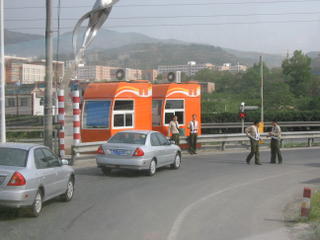
That may be, but then, you could also do what they do in China, and plop down one of these portable toll booths wherever you feel like it. If it doesn't work out like you want, just snatch it up and put it somewhere else.

For that matter, you can add and subtract them at will. Need more repair money between mile markers 121 and 138? Drop an extra booth or two. Traffic too fast between Fayetteville and Lumberton? Add more toll booths and slow it down. Business slow in Kenly? Put three or four between US 301 and US 264 at Wilson, and I'll bet commerce picks up ... along with the collective blood pressure.

And you're not even considering the possibilities along the secondary roads. What fun.

A simple rule

John Hood's comments about video games earlier this week were just a few days ahead of WPTF's Kevin Miller, who interviewed attorney Jack Thompson about his work against the increasing violence and prurient content of video games, and the BBC's story on the same subject.

We adopted a very simple rule with our boys some time ago, based on Proverbs 14:9 (Fools laugh at sin ...) -- whatever would not be permitted in reality, isn't permitted in fun, either. Sin is serious, play is practice for life, and we don't rehearse things which should require repentence.

Carried out consistently, this answers a lot of questions. Combat flight simulators are okay, because there is an honorable service to country; Grand Theft Auto is not. Leading armies into battle is okay -- the boys love the Civilization II and Age of Empires games -- but rapine and pillage are not. Historic simulations and "what if" scenarios that may be played out are educational, but when the secret code unleashes flying sports cars with machine guns to slaughter the knights of the Second Crusade -- you've just stepped out of bounds. It's even acceptable to be Pharoah of Egypt, but we draw the line at building his temples (Thou shalt have no other gods before Me; Thou shalt not make unto thee any graven image ... )

This rule works on the computer or off -- for example, you're not allowed to pretend to shoot your brother, but both of you are allowed to shoot imaginary villains and invaders, in order to defend your home or country. To facilitate this, we require the boys to all be on the same "team" when pretending this way; it can't always be done in sports or some other games -- and sometimes we see hurt feelings and unchristian behavior as a consequence.

Some folks have looked at us a bit funny, finding that we allow toy guns but discipline the boys if they point them at each other. Sometimes it's a fine line, I freely admit. But part of being a man is knowing the proper boundaries of the use of force, and the proper application of doctrine and character to life -- requirements of the groups of men we call "governments", too. And I want my sons prepared for both roles.

Flat Earth

My review of Thomas Friedman's book on globalism in business, The World Is Flat , appears in the August issue of Carolina Journal, page 20.

RALEIGH -- Many of us have spoken with call-center operators in Bangalore, India, and would be only slightly surprised that Wal-Mart is China’s eighth largest trading partner — larger than most nations. I was surprised, though, to hear a Hispanic acquaintance worry over the impact that globalization was having on his friends’ businesses in Mexico. Thomas Friedman says our NAFTA partner hears the "giant sucking sound" in stereo.

Welcome to Thomas Friedman’s new book, The World Is Flat. In it, he posits three historic periods of global development — the age of discovery and colonization, followed by a period of business consolidation and growth across national boundaries, and now dawning on an age of information transfer and knowledge workers, spread out and settled in wherever an Internet connection can be made. As the traditional model of vertically integrated, heavily hierarchical corporations converts to a horizontal and collaborative network of contractors, partnerships, and offshore talent, Friedman says the world is flattening, and barriers to trade, culture, and thought are coming down. Not everyone likes it, though.

RTWT here.

For God's sake

There is a danger in reading too much into providential situations. The sky clears overhead in time for your parade, and you (properly) bless God, but don't recognize you may be participating in someone else's direct intervention. The blue sky was not about you at all, though you're welcome to enjoy it when it comes.

I was reading in Ezekiel recently and noticed, again, how directly he speaks to our generation. In chapter 20, the elders of Israel came to the prophet seeking a word from the Lord; His word, it seems, was "Go away".

"Son of man, speak to the elders of Israel and say to them, '"Have you come to ask of Me? As I live," says the Lord Jehovah, "I will not be inquired of by you."'" (20:3)

He then lays out the pattern of Israel's history -- God reveals Himself to Israel, who then ignores or repudiates His commandments, leading God to purpose judgment against them ... but repeatedly, to relent. Why?

"But I worked for My name's sake, that it should not be profaned before the nations among whom they were" (20:9, cf 20:14, 22)

This went on from 1447 B.C. to the 590's, when Ezekiel began his ministry.

The blow falls in verse 39 -- "'And you, O house of Israel,' so says the Lord Jehovah: 'Every man go and serve his idols, and do so from now on if you will not listen to Me. But never again defile My holy name with your gifts and your idols.'"

To be written off by the only Hope is a fearful thing.

We are fools to think that God's apparent mercy toward us in our rebellion is solely for our good. Here is God's own chosen nation, placing itself in opposition to Him time and again, and spared -- not because they are worth it, but because it would dishonor God's name in the sight of the world to do otherwise. Israel was not chosen because they were special, but the other way around. And their time eventually ran out.

We need to pay attention here, individually, corporately, nationally. Even in repentence, He reminds us of the same overriding fact:

"'And you shall know that I am the LORD when I have worked with you for My name's sake, not according to your wicked ways nor according to your corrupt doings, O house of Israel,' says the Lord Jehovah." (20:44)

It is a hallmark of His providence that any blessing bestowed is a matter of grace to the undeserving. Ultimately, it's not about us at all, ever; it's all about God, and His honor. For what, indeed, is the chief end of man?

Monday, August 08, 2005

Why, indeed

I was part of a conversation with the owner of a Christian bookstore catering to homeschoolers. In her area she meets a number of parents who come in looking for curriculum but specifying, very definitely, they do not want materials with a Christian flavor to them, and do not want their children exposed to Christian teaching.

She told me she is in business to serve whomever needs help, so she guides them to books which meet their specification. She mused, though, over how often these same parents will ask her, "Why is all the good stuff Christian?"

I read a similar comment online this weekend, where a mother in Arizona is starting a homeschool organization for Pagans. She mentions as part of her inspiration that she had attended a high school graduation presented by Arizona Families for Home Education, saying "the ceremony was beautiful and seeing so many homeschoolers graduate was amazing ..." (link here for attribution, not endorsement)

Why indeed. My friend's response about the benefit of starting with Truth as your foundation was said in love, and accurate. The question which came to my mind, though, was what prevents the same question from rising in relation to any other field -- art, music, engineering, medicine, literature. Why not?

Take it seriously

Ye who think of sin but lightly
Nor suppose the evil great
Here may view its nature rightly,
Here its guilt may estimate.

Mark the Sacrifice appointed,
See who bears the awful load;
'Tis the Word, the Lord's Anointed,
Son of Man and Son of God.

-- Thomas Kelly (1769-1855)
"Stricken, smitten, and afflicted" (No. 192)
Tune: O Mein Jesu, Ich Muss Sterben
From the Geistliche Volkslieder

Friday, August 05, 2005

A policeman's lot is not an 'appy one

Shades of Raiders of the Lost Ark: Policemen in Michigan had to unholster a stun gun when a hit-and-run driver confronts them in medieval garb -- long sword and all.

Closer to home, a teenaged girl is in jail charged with aggravated (aggravating?) assault after spitting on a Cary, N.C. police officer.

And in St Petersburg, Florida, police chief Chuck Harmon says it was not a violation of policy for officers to handcuff a five-year-old schoolchild.

"This child needed some intervention, but I don't think it was by law enforcement," Harmon said, calling the handcuffing "premature."

We don't pay these guys enough for the nonsense they have to put up with.

Sunday, July 24, 2005

A reliable friend

One there is, above all others, Well deserves the name of friend;
His is love beyond a brother's, Costly, free, and knows no end:
They who once his kindness prove,
Find it everlasting love!

Which of all our friends to save us, Could or would have shed their blood?
But our Jesus died to have us, Reconciled, in him to God:
This was boundless love indeed!
Jesus is a friend in need.

Could we bear from one another, What he daily bears from us?
Yet this glorious Friend and Brother, Loves us though we treat him thus:
Though for good we render ill,
He accounts us brethren still.

O for grace our hearts to soften! Teach us, Lord, at length to love;
We, alas! forget too often, What a Friend we have above:
But when home our souls are brought,
We will love thee as we ought.

-- John Newton, 1779 (Olney Hymns) -- Tune: Godesberg

Tuesday, July 19, 2005

Touring the Bypass

This weekend my sons and I took a first trip on the new U.S. 64 bypass around Knightdale. I spent a couple of months working on a project at the Milburnie substation, smack in the middle of the bypassed section of "Old 64", and I can testify there was no joy coming or going during rush hour traffic.

Still, I think the new bypass will always be connected with the day I put my hand on a 500,000 - volt power line.

Of course the power was off, or I would have ended up like a six-foot pork rind in a blue shirt. Progress Energy had to relocate a steel lattice transmission tower farther back (and higher above) the new road's right of way, and in the neatest piece of construction work I've ever watched, the crew unbolted the base of the tower, lifted it sixty feet in the air, and landed it on a new base a hundred fifty feet up the line. Six of the nine cables were lowered to the ground (the other triplet was inaccessible, routed through the center of the tower), which gave me the creepy opportunity to lay hands on a once- and soon-to-be very high energy cable. Power lines aren't insulated, you know, just bundles of bare aluminum and steel.

This tower is on the north side of the new highway just west of Smithfield Road, at exit 425 .

There are some other points of interest along the Triangle's newest highway. The environmental walls transition from "North Raleigh brick" close to the Beltline, to a more utilitarian concrete-with-pebbles closer to Knightdale. The biggest piece of natural stone I've seen in Wake County is hunkering behind a barn on the south side of the road at mile marker 422 . There's a fully-signaled railroad crossing, with automatic gates and all, on a road that no longer crosses the tracks -- it was truncated by the six-lane bypass at mile marker 421 , on the north side.

Knightdale's water tower would earn the "Doorknob to Hell" nickname we assigned to a similar structure at college; it's visible, obvious, and freshly painted, so no mile marker needed. And the graceful junction of US 64 and the Beltline at Poole Road, with its interlaced bridges above I-440, is punctuated on the westbound side by an arabesque around the sewage pumping station inside the Inner Beltline -- an unexpected sensory experience.

The scenery along the eleven-mile ride is rural Wake County, but not for long. It might be advisable to enjoy the trip while deer sightings are still likely and the tire debris is infrequent -- the traffic is already picking up.

Wednesday, July 06, 2005

Kyoto? Try a little further west


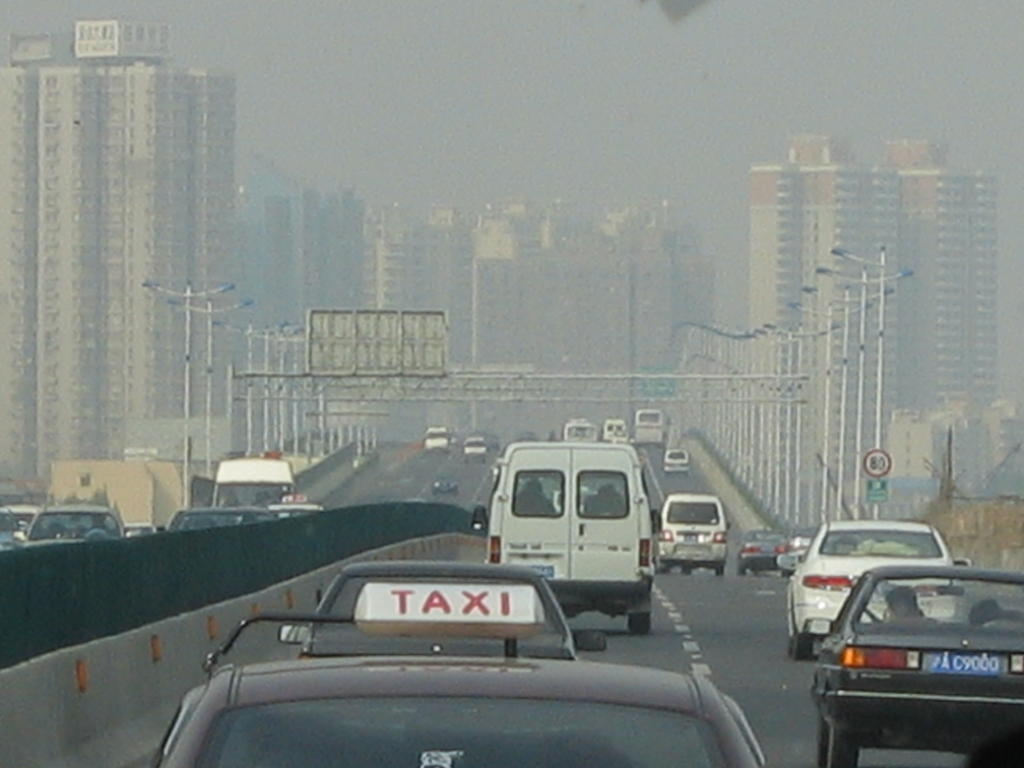
Ah, spring in Shanghai.

Joseph Coletti at the John Locke Foundation posted a comment on the Locker Room today about a new way the U.S. can "participate" in the Kyoto accords -- by voluntarily doing whatever it takes to make our air better than it was fifteen years ago.

Before we go torpedo our economy, though, let's take another look at countries whose air quality is not subject to the Kyoto agreement -- like Japan's very large neighbor just to the west.

Tuesday, July 05, 2005

Explosions near resort entertain 13

No injuries reported

(LITCHFIELD BEACH, S.C.) -- A series of explosions shortly after dark on Sunday left thirteen family members entertained, although two fell asleep during the incident. Shadowy figures seen moving about the area were not investigated and apparently no crimes were committed.

Following the News & Observer's article about fireworks safety -- and the legend on their graphic that only "safe and sane" fireworks were legal in North Carolina -- our family's annual visit to the Palmetto State resulted in the purchase and ignition of about $33 of apparently unsafe and insane projectiles. South Carolina still has the admirable rule that if you can buy it, you can shoot it off, which has made it the envy of small boys and scofflaws from all the surrounding states. And I had a bag full of just about everything off-limits in Tarhelia.

Spending $33 is pretty small potatoes, to be sure, but we were never a do-you-itself family when it came to fireworks (whether stemming from homes inside the city limits or a certain economy on the part of my parents, I don't know). Still, this was the first time we've done it "at home"; since my work schedule precluded staying up for the professionals on Monday, we decided to have our celebration a day early. There weren't any duds in the bag, either.

So where's the insanity? Near as I can tell, all the consumer fireworks have warnings actually written by English-speaking people (not true of every Chinese import), basically saying "Don't hang on to this when the fuse is lit" and "Explosions throw things and hurt people". Anything else we need to worry about?

Oddly enough, the one thing missing is the only thing which I have ever found to put my family in real and imminent danger -- not amateur pyros, but amateurs full of alcohol. The next group up the beach managed to tip over their mortar -- I am certain they were not shooting the two-inch, two-for-$12 variety I picked up, either -- and lay a nice trail of smoke up the dunes and under their deck. I didn't actually witness the moment of mayhem but I'd say they sure got their money's worth from that munition.

To be fair, their chrysanthemum shell which went off about twelve feet in the air (producing something which looked like a twenty-foot dandelion head sitting on the beach) may have been a fluke.

Maybe instead of restricting the sale of the fireworks, our own state could just make it a class two misdemeanor to shoot them off while pickled, or to utilize aerial displays as wannabe weapons of mass destruction. In other words, let's penalize the operator who behaves irresponsibly, not shut down the whole world over the possibility.

And next time buy more of the rockets with nose cones -- they were almost as good as the mortar.

Convention write-up in the July Carolina Journal

The July issue of the John Locke Foundation's Carolina Journal has my write-up of NCHE's annual convention, over Memorial Day weekend. The editors gave it the title "Homeschool convention packs them in", appropriate since there we had well over eight thousand people there.

The story's on pages 10-11 of the pdf version here.

Thursday, June 30, 2005

Caffeirrhythmia

(n.) The attainment of perfect synchronization with the office coffee brewing cycle. This may be in phase at any point; for example, on Monday I personally made six pots of coffee during the day.

Given three pots of coffee of two varieties (but one pot marked and reserved for decaf), I wonder what the numeric representation of the system would be. I spoke with my colleague who manages that part of the break room yesterday and was told we are one of our coffee service's biggest clients. When I asked if that was we our company or we our floor, he said it was the 18th floor by itself. Altogether we go through about nine pounds a week, 2:1 regular to decaf, plus all the creamers, tea bags, and other associated flotsam.

Wednesday, June 29, 2005

A Definition of The State

Today is the 204th birthday of French economist Frédéric Bastiat, author of The Law and other works. The Foundation for Economic Education has Bastiat's 1849 essay "The State" online; he has nice things to say about the American Constitution in comparison with his own country's, but the rest of the essay sounds ominously current.

I wish someone would offer a prize—not of a hundred francs but of a million, with crowns, medals, and ribbons—for a good, simple, intelligible definition of the term, The State.

What an immense service such a definition would render to society!

The State! What is it? Where is it? What does it do? What should it do? We only know that it is a mysterious being; and, it is certainly the most petitioned, the most harassed, the most bustling, the most advised, the most reproached, the most invoked, and the most challenged of any being in the world. ...

Man recoils from effort, from suffering. Yet, he is condemned by nature to the suffering of privation if he does not make the effort to work. He has only a choice then, between these two: privation, and work. How can he manage to avoid both? He always has and always will find, only one means: to enjoy the labor of others; to arrange it so that the effort and the satisfaction do not fall upon each in their natural proportion, but that some would bear all the effort while all the satisfaction would go to others. ...


"I am dissatisfied with the ratio between my labor and my pleasures. In order to establish the desired balance, I should like to take part of the possessions of others. But that is a dangerous thing. Couldn’t you facilitate it for me? Couldn’t you give me a good post? Or restrain my competitors’ business? Or perhaps lend me some interest-free capital, which you will have taken from its rightful owners? Or bring up my children at the taxpayers’ expense? Or grant me a subsidy? Or assure me a pension when I reach my fiftieth year? By this means I shall achieve my goal with an easy conscience, for the law will have acted for me. Thus I shall have all the advantages of plunder, without the risk or the disgrace!" All of us are petitioning The State in this manner, yet it has been proven that The State has no means of granting privileges to some without adding to the labor of others.


The State is the great fiction through which everybody endeavors to live at the expense of everybody.

Sunday, June 26, 2005

Providential!

My wife and I encountered R.C. Sproul Jr.'s blog yesterday, and cruising the Internet with a sleepless baby tonight, I discovered he was writing an excellent essay on the thirteenth-floor phenomenon the same day I was. Neat.

Thursday, June 23, 2005

Template change

Testing a different template today but still not 100% happy with it.

Wednesday, June 22, 2005

First articles in Carolina Journal

My first articles for Carolina Journal appeared in the May 2005 issue -- two of them:

"State abandons plan to move DNPE" (p.10) concerning the history of the separation between public and private education agencies in North Carolina. A near re-union was narrowly headed off this spring. Why interfere with an arrangement which has promoted this voluntary choice that collectively saves taxpayers over $980 million annually?

The story was picked up by the
Johnston County Republican Party and posted on their website with permission

I also have the book review "The Essential Ronald Reagan: Lean yet true to his simple style" (p. 21) which I mentioned in an earlier post.

Puritan support for classical education

Here Richard Baxter (1615-1691) addresses the usefulness of liberal education:

Question 158. Should not christians [sic] take up with Scripture wisdom only, without studying philosophy and other heathens' human learning?

Answer. I have already proved the usefulness of common knowledge in my book called The Unreasonableness of Infidelity, part 2, section 23, page 163, to which I refer the reader; and only say now,

1. Grace presupposeth nature; we are men in order of nature at least before we are saints, and reason is before supernatural revelation.

2. Common knowledge therefore is subservient unto faith: we must know the Creator and his works; and the Redeemer restoreth us to the due knowledge of the Creator: human learning in the sense in question is also divine, God is the author of the light of nature, as well as of grace. We have more than heathens, but must not therefore have less, and cast away the good that is common to them and us; else we much not have souls, bodies, reason, health, time, meat, drink, clothes, etc., because heathens have them. God's works are honourable, sought out of all them that have pleasure therein; and physical philosophy is nothing but the knowledge of God's works.

3. And the knowledge of languages is necessary both for human converse, and for understanding the Scriptures themselves. The Scriptures contain not a Greek and Hebrew grammar to understand the languages in which they are written, but suppose us otherwise taught those tongues that we may interpret them.

4. The use of the gospel is not to teach us all things needful to be known; but to teach us, on supposition of our common knowledge, how to advance higher to supernatural saving knowledge, faith, love, and practice. Scripture telleth us not how to build a house, to plough, sow, weave, or make our works of art. Every one that learneth his country tongue of his parents hath human learning of the same sort with the learning of Greek and Hebrew; he that learneth not to read, cannot read the Bible. And he that understandeth it not in the original tongues, must trust other men's words that have human learning, or else remain a stranger to it.

(f.n. Pr 2-6; Ps 92:5-6; Ps 104:24-25; Ps 113:5-6; Ps 107:8, 15, 21; Ps 66:3-4; Ps 111:2-6; Ps 145:7-11, 17-19; Acts 2:6-9; Acts 21:40; Acts 24:2; 1 Cor 14:2, 4, 9, 13, 14, 19, 26, 27; Rev 9:11; Rev 14:16; Rev 5:9; Ps 19:1-3; Ps 94:10; Ps 139:6; Pr 2:1-4, 8-10,12; 1 Cor 15:34; Pr 19:2; Job 32:8; Job 38:36. Yet I refer the reader to my "Treatise of Knowledge", which showeth the vanity of pretended learning.)

But though none but proud fools will deny the need of that human learning which improveth nature, and is subservient to our knowledge of supernatural revelations, yet well doth Paul admonish us, to take heed that none deceive us by vain philosophy; and saith that the wisdom of the world is foolishness with God, and that the knowledge of Christ crucified is the true christian philosophy of wisdom. For indeed the dark philosophers groping after the knowledge of God, did frequently stumble, and did introduce abundance of logical and physical vanities, uncertainties, and falsities, under the name of philosophy, by mere niceties and high pretendings, seeking for the glory of wisdom to themselves; whenas it is one thing to know God's works and God in them, and another thing to compose a system of physics and metaphysics containing abundance of errors and confusion, and jumbling a few certainties with a great many uncertainties and untruths, and every sect pulling down what others asserted, and all of them disproving the methods and assertions of others, and one proving their own. And the truth is, after all latter discoveries, there is yet so much error, darkness, uncertainty, and confusion in the philosophy of every pretending sect, (the Peripatetics, the Stoics, the Pythagoreans and Platonists, much more the Epicureans, the Lullianists, and Cartesians, Telesius, Campanella, Patricius, Gassendus, etc.) that it is a wonder that any that ever thoroughly tried them, can be so weak as to glory much of the certainties and methods of any, which hitherto are so palpably uncertain, and full of certain errors.

We may therefore make use of all true human learning, real and organical, (and he is the happy scholar who fasteneth upon the certain and the useful parts well distinguished from the rest, and truly useth them to their great and proper ends): but niceties and fooleries which some spend their lives in for mere ostentation, and also uncertain presumptions, should be much neglected; and the great, certain, necessary, saving verities of morality and the gospel must be dearly loved, and thankfully embraced, and studiously learned, and faithfully practised, by all that would prove wise men at last.

(f.n. Col 2:8,9,23; 1 Cor 2:1,4-6,13; 1 Cor 3:19; 2 Cor 1:12; Job 28:28; Prov 1:7; Prov 9:10; John 18:3; Gal 4:9; Eph 3:10; 1 John 2:13,14; Col 1:9,27,28; Eph 6:19; 1 Cor 2:11; Col 3:16; Acts 17:18,19; Eph 4:18,19; Hos 4:8; Hos 6:6; Ps 119:99; 2 Pet 3:18; 2 Pet 1:3,5,8; Col 2:3; Col 3:10; Phil 3:8; Eph 3:19; Eph 1:17; Rom 1:20-22; Eccl 1:16-18; 1 Cor 8:1, 11; 1 Cor 13:2,3,8,9; Rom 2:20; James 3:13,14,17; Jer 4:22; 1 Cor 8:2)

Richard Baxter, A Christian Directory, "Christian Ecclesiastics", pp721-722 (Soli Deo Gloria reprint of the 1846 edition; some formatting changed for readability here)

Sunday, June 19, 2005

Choose one and stick with it

Due to project deadline issues, this morning I find myself in the cubicle instead of the pew*. On the way in, I heard a pastor on the radio explaining the significance of infant baptism, which he had just performed.

"That's what baptism is about ... It's an outward sign of an inward conviction."

Granted; I just don't see how he can administer an outward sign to signify the Christian faith held inwardly by a baby who at the very least is not able to communicate a convincing testimony to this well-meaning pastor.

The "New Testament fulfillment of circumcision" is more convincing than this argument; if he's going to uphold paedobaptist practice, he ought not to borrow credobaptist explanations.

*So to speak. Our church has chairs, actually.

Friday, June 10, 2005

A few words on classical education

The reporter asked me about classical education and homeschooling; it's growing in popularity here in the Triangle, both at home and in the private schools.

Schools go back for future
'Classical' education pushed by new school, headmaster

By Kinea White - North Raleigh News - 6/10/05

Wednesday, June 08, 2005

Sic transit gloria mundi

This item fits into so many categories it's hard to specify.

Recently Human Events published its list of the Ten Most Harmful Books of the 19th and 20th Centuries, as suggested by their panel of scholars. Number three on the list (being edged out by his guru Marx and Ueberteufel Hitler) was Mao Zedong's infamous "Little Red Book", The Quotations of Chairman Mao Zedong.

Item: President Reagan said that communism would be relegated to the ash heap of history. Mao's public image hasn't reached that stage yet, but in the rapidly-westernizing Shanghai, it's made it to the side streets. Mao only appears on kitschy wrist-watches and other souvenirs in the street markets, with the single noticeable exception of his portait in Tiananmen Square -- and Beijing is not Shanghai.

Likewise his book -- there's no shortage of original copies, in stacks alongside the fake ancient coins, made-yesterday antique knives, and other trinkets. I was quoted 100 RMB, about $12.50, for one, and snorted at it -- I offered 10 RMB, we settled on 25 RMB, and I still overpaid. IOW the first edition of this monstrosity -- you can't call it a "best seller" if it's given away, can you? -- can be had for about $3 if you don't haggle too hard.

Item: Over here, apparently, there's more demand. Amazon this morning had several used copies for sale, starting at $45 and on up to $75.

Gimme a break. I wouldn't give you $20 for the entirety of Chairman Mao Thought, let alone the Reader's Digest edition.

Monday, June 06, 2005

Interview with a veteran home educator

The June issue of Carolina Journal includes my interview with Gray Sullivan, a long-term homeschooling mom in Goldsboro, whose oldest son Micah graduated with honors from N.C. State this May ... just in time for Gray to begin homeschooling her youngest child, her six-year-old daughter. And she's totally committed to the whole exercise -- the article is "The Pursuit of Happiness, At Home", on pages 8-9 here.

I've known the Sullivans for a number of years and they are truly terrific people. I'm glad I got to shine a spotlight on them for a bit -- they have been an example and encouragement to so many people.

Wednesday, June 01, 2005

Fear of death and the conservation of numbers

I mentioned that the word "four" in Mandarin, sì, is very close in pronunciation to the word "death", . This is deeply rooted in their culture -- to the point that it is bad form to give a someone a gift with four of something; sets of things like tea cups more often had six rather than four items. I've heard that phone companies offer discounts to subscribers who accept numbers with a 4 in them.

(FWIW you don't give a clock to somebody either, because "give a clock" - gĕi jĭ shí zhōng - is close in pronunciation to "attend a burial" - chū xí zàng lĭ. Watches, however, are okay. But that's another story.)

The apartments where we stayed in Shanghai were a vivid illustration of four-phobia. I couldn't figure out why the elevator buttons didn't line up properly -- they didn't seem to be multiples of anything, and I always had to search to find the right button. I suddenly recognized why -- not only did they omit the 13th floor, like many older American buildings do, but also the 4th, 14th, and 24th floors.

So when you stood on the nominal 26th floor of this building, you were actually only twenty-two stories above the street. And inside, there was no apartment "4" on any floor -- 1-2-3-5-6-7.

It reminded me of the passage in Hebrews, which says that He [Christ] also Himself likewise partook of the same [flesh and blood nature]; that through death He might destroy him who had the power of death … and deliver those who through fear of death were all their lifetime subject to bondage. (Hebrews 2:14-15) It was palpable over there.

Until I was free of that same fear, I didn't realize how great a burden it was to carry.

For to me, to live is Christ, and to die is gain. (Philippians 1:21)


Tuesday, May 24, 2005

On math education

In a discussion of Nickels' Mathematics: Is God Silent?, I turned up this paragraph in the author's story of how the book came about:

I transferred to Fresno State College for my final two years. Although I still got As in every math class, my professors drilled me in dry formalism semester after semester. As the course material advanced beyond differential and integral calculus, it seemed like I had entered into an n dimensional domain of transcendent abstract analysis, aimed not at the Elysian fields of delight, but at the specter of the null and the void. These spiraling integrations into the void numbed and dizzied my mind. The phrase – integration into the void – was coined by the great 20th century Christian apologist Cornelius Van Til of whom we will hear more about later. I still managed, in 1973, to receive my undergraduate degree in mathematics (graduating summa cum laude – which proves that getting good grades does not mean that you have been properly educated). On graduation day I made an internal vow, “I will never open another math book again as long as I live.” Fortunately, I rescinded that vow some 5 years later. My response to four years of university training is a sad commentary on the state of university education then and, even more so, today.

Tuesday, May 17, 2005

Exam results

We're back and basically recovered from the jet lag -- the west-to-east travel is awful though the effects don't set in immediately.

Re: the crash course in conversational Mandarin, I'd have to say it was a success. The Chinese, particularly in Shanghai, told us we had very good pronunciation ("Perfect Beijing" they said). One indication of it was that when they got over the initial shock, they assumed we must be fluent and therefore launched a full salvo of Mandarin our way.

"Wǒ shuō de bù hǎo -- Wǒ huì shuō yī diǎn pǔtōng huà!"

"I do not speak well -- I can speak [only] a little Mandarin!"

It was amusing how startled the Chinese were when an American spoke Mandarin to them, even a short sentence like, "Excuse me, do you speak English?" The reaction was as if they'd reached down to pet the dog and the dog had said, "Good morning, sir!" in perfect Chinese. I suspect they have non-Asian foreigners mentally filed in the "Other" category, and while they didn't ignore us -- no, definitely did not -- they don't expect to interact with us much unless they're selling something or curious about the children.

John in particular held his own quite well. It was common to turn around from a museum exhibit or a street vendor to find John, a good eighteen inches taller than anyone nearby, explaining our family to a circle of admiring Chinese. Melanie also did very well bargaining with vendors and "good-willing" with the baby.

My own biggest adventure was negotiating the purchase of a euphonium in a Shanghai music store with the help of a calculator and Langensheidt's dictionary. ("New?" ... "No, sample." ... "I understand ... Case? Box?" ... "Wait …")

The downside for me was the experience of almost total illiteracy. Other than signs in pinyin and a few in English, there was little recourse to the printed word. I haven't felt this stupid since I was in kindergarten. In Europe, even if you don't speak the local language, you can usually take a guess based on cognates, Latin roots, or shared structures. Not in China -- you not only have no common language, you can't even guess a pronunciation from the characters on the sign.

I don't think we were alone in this, though. In fact, it seemed like the Chinese were often arguing among themselves over something or another. Melanie is convinced that they don't share a common language, either.

Wednesday, April 20, 2005

Fifty hours and a final exam

Is it possible to learn to speak Chinese in a week?

I doubt it, but my son John and I are finishing up a fifty-hour experiment in Mandarin immersion -- thirty hours of instructional CDs , ten hours in the classroom, and ten hours of tutoring with a Shanghainese college student. It's spread out over ten weeks or so, but the total is just over a week.

Observations: While the grammar is simple -- the verbs don't conjugate and the nouns are the same regardless of number or gender -- the pronunciation has been a puzzlement. The use of four major tones as well as a neutral or flat tone, plus an umlauted /u/, mean that Mandarin has in effect thirty vowels -- at least, the way I see it. This straightforward exchange illustrates the challenge:

"Shì sì suì? Haíshì shì shí sì suì?" -- "Bu shì, shì sì shí sì suì, keshì shì sĭ."

Translation: "Is it four years old? Or is it fourteen years old?" -- "No, it is forty-four years old, but it is dead."

The pronunciation sounds something like "Sh-ss-sw? High sh-sh-ss-sw?" -- "Boo-sh, sh-ss-sh-ss-sw, k'sh sh-ss." Granted, this is a tongue twister even for the Chinese, but for an American, distinguishing the difference between "shì" (to be) and "shí" (ten), or between "sì" (four) and "sĭ " (dead), takes a new level of concentration. And this doesn't even begin to address the written characters - if it weren't for the romanized "pinyin" I'd be totally illiterate.

Final exam starts soon. Results will be posted afterward.

Thursday, April 07, 2005

Books on China

I've been trying to catch up some on the Far Eastern side of history and culture, but with mixed results.

The Cambridge Illustrated History of China - author?. John Hood at the John Locke Foundation loaned me his copy; somehow I knew someone up there could recommend a history. A thorough overview of the country; amazing how much I simply never heard of, and interesting to consider how long China has been a nation -- National Geographic compared the Han Dynasty with the roughly coincidental Roman Empire, but there's not a comparable entity in European history. The absence of a timeline, anywhere, was perplexing, though; it would have been helpful for me if there were more crossreferences to Western history, to highlight the advances in technology which didn't reach Europe for centuries after the Chinese put them in practice.
Art: Good / Message: Neutral / Kids: One or two illustrations may be problematic / Read more: Possibly.

The Art of War - Sun Tzu. An ROTC friend loaned it to me in college; this time I borrowed from the corporate library. A rediscovered classic; the anecdotes added over the centuries are sometimes better than the original text. My favorite this reading is "the doctrine of the sheathed sword" -- the successful general will find a strategem leading to victory without a fight. A little tiring to read but not overlong.
Art: OK / Message: OK / Kids: OK / Read more: ??

The Good Earth - Pearl S. Buck. An excellent example of good art, mixed message. Peasant farmer Wang Lung raises his family to the first levels of landed prosperity through hard work and patient suffering. He has a basic sense of shame and pity, exhibits the Confucian virtue of filial piety, and shows a general unexamined sense of ethical behavior; if Francis Schaeffer had been Chinese, he would have called this "the Confucian memory". Wang's gentleness toward his profoundly handicapped daughter ("My poor fool"), in a time when she might have simply been killed off, is a highlight.

On the other hand, Wang worships idols of clay; winks at infanticide; enriches himself with stolen goods; consorts with a prostitute and eventually buys one as a rival to his longsuffering wife O-lan; entices his troublesome uncle and aunt into opium addiction; and generally makes an idol of his land. The ambiguous ending suggests his financial success has led his sons away from his own basic virtues, and Wang Lung's decline into adultery, while reminiscent of David's, dwells too much and too long on his lusts.
Art: Excellent / Message: Mixed / Kids: No / Read more: Maybe

Judge Dee at Work - Robert van Gulik. Five short stories about 7th-century magistrate in China, solving local crimes and administering rough justice. No Brother Cadfael, this - nearly every woman in the book is a "courtesan", though that fact is treated as stage dressing generally. How prevalent that was in historical context I don't know but it pushes this lower on the message side. Judge Dee is fair enough as a jurist but the dialogue is implausible and the style is tiresome.
Art: Fair / Message: Fair / Kids: No / Read more: No

Wednesday, April 06, 2005

Now that you mention it

I started the evening commute yesterday with a conference call on my cell phone , with six other people, and found myself on the same cell phone at 11:45 p.m., talking with a freelance writer in Hawaii who wanted to know about North Carolina's statutory attendance laws. This article showed up in the morning e-mail, and while it's nothing new it was certainly well-timed. Northern China, here we come.

The essence of the man

The Heritage Foundation send my wife and I a signed copy of Lee Edwards' new book, The Essential Ronald Reagan, as thanks for help with a local project. This is a short (155 page) overview of Reagan's life, including in the introduction both the North Carolina turnaround in his 1980 presidential bid and the worldwide response to his death in June 2004, by a long-time biographer of the president.

I have a longer review being considered by a state news magazine, but I can say one of the most impressive things I learned about Reagan is that the "intellectual lightweight" reputation was totally an invention of a hostile media. Reagan was actually very well-informed, a voracious reader from the start, but a genius at distilling complex issues into a few key principles. This gave him a clarity of thought and expression that more "nuanced" commentators disdain as shallowness, while in fact it was part of his strength.

An excellent book with an interesting critique of other works on Reagan, including Edmund Morris' authorized biography, Dutch (Edwards found it disappointing).

Tuesday, April 05, 2005

Oh, it's nothing, just a little typhoid

With a trip to China coming up, various experts recommended I get vaccinated for hepatitis A, a tetanus booster, and most interesting, typhoid fever. That last vaccine comes in a couple of forms, either injectable or oral. Due to the number of victims and relief workers connected with December's tsunami, we've found a shortage of typhoid vaccine in the U.S., and I've ended up taking the oral form. The relevant detail about that is that unlike the injectable vaccine, this is a live product -- genetically defused, sort of, so I don't get The Full Experience, but nevertheless, a low-grade typhoid infection.

The side effects can be "mildly" unpleasant, but it is typhoid, after all. The package insert says

The overall symptom rates from both studies when vaccinated with capsules were combined and shown to be: abdominal pain (6.4%), nausea (5.8%), headache (4.8%), fever (3.3%), diarrhea (2.9%), vomiting (1.5%) and skin rash (1.0%).


Well, call me statistically significant. All I can say is that when one quarter dose produces a reaction within the hour (the oral vaccine is four capsules taken over six days), I'm sure glad I'll have some immunity to the real thing when I get there. Meanwhile I'll just have to deal with "mild flu-like symptoms" for a few days.

Don't tell my office mates.


Thursday, March 31, 2005

Mud

I was reading Thomas Watson's The Lord's Prayer this morning and looking at the very first phrase, "Our Father". Watson comments that all men can claim Him as Creator and Judge, but only His children can call Him Father. What's more, we are just "dust with sin mingled", and yet the Lord of Hosts gladly claims us as His own possession. I am trying to get my brain around this.

Reading the Puritans is like eating fudge -- the stuff is so rich it's hard to handle in large chunks.

Wednesday, March 30, 2005

Beginning Chinese

Here are my observations, after several weeks of "beginning Chinese":

1. The most common word in Mandarin is sh. Depending on inflection, this means "is" (sh.), the number 10 (sh!), or "to eat" (sh-), or maybe "to go" (sh) unless it occurs at the end of a word like -shi, meaning a master of something. Practice this.

Note: This is easily confused with the word s! which means "four".

2. The most common sound in Mandarin is /tchzz/. This is spelled ch, ts, z, zh, j, x, or q. I am not making this up. As a word, for example, j means "to eat" or "know" (with dao). I know I said sh means "to eat". It's the same thing.

3. You should not confuse the word ma (horse) or ma! (mother) with the word ma , which is a question word like the Candian eh? Questions in Chinese always sound Canadian, like "You are American, ma?"

4. You should always be sure to distinguish zhong! (the center of something) from zhong! (clock) and Zhong- (Chinese), not to mention zhong! which is the sound made by a gong. Gong however means "work".

5. You should always respond to comments about your excellent Chinese ("Knee pooting whah shoot the hen house!") with the modest statement, "Why, shoot the blue cow!", which means "I do not speak well."

6. It is rude to interrupt someone and say "Gesundheit" if they say cashew, which is a conjunction, "but"

7. Ta means he, she, or it. It's obvious if it's written.

8. Zi! Nar? means "Where?" Zi! Nar! means "Over there." Zi! Jar! means "Rat cheer."

9. Wo? means "I" but it can also mean "me", "my", or "mine". Women means "we" but it also means "us", "our", and "ours".

10. The number "two" is pronounced are? but you don't use it for people or beer.

11. If you have a Western name, you might be given a phonetic equivalent by combining Mandarin words to yield roughly the same sound. From the Chinese translation of the Bible, then, "John" naturally becomes Yue Han which seems to mean "monthly check" but sounds vaguely like "Johann". Likewise, "Caleb" becomes Jia Lei which appears to mean "Lord Buddha strangles" and doesn't sound like "Caleb" at all.

More helpful information to follow as we learn even more useful Mandarin phrases.

Monday, March 21, 2005

Busy, Busy, Busy

It has not been a quiet week in Lake Wobegon, not this one. There have been several deadlines since the last post, including two articles for publication (my regular column in NCHE's Greenhouse Report and a revision of a previously published piece, to go in the Florida Parent Educators Association magazine, Agenda)

BTW, after much innocent merriment by my fellow board members, my column was given the name "Hal's About It" (I decided it was less edgy than "Hal, Caesar" or "What the Hal"). After cranking out about fifteen of these the past couple of years, I wonder if readers aren't asking, "Isn't there something better than this?" and finding the answer is, no, Hal's about it.

Anyway, the push to finish several projects in short order has left little time for blogging, other than a few posts at The Locker Room and a few news items for NCHE's statewide blog page.

Back at the ranch, we are making an effort to learn basic Chinese -- everyone over the age of two. Eldest son John and I are taking a "Chinese As a Second Language" class at the Raleigh Academy of the Chinese Language (meeting in a church every Saturday), while we're all reviewing the Pimsleur Method CDs and spending an hour on Sunday afternoons with a student from Shanghai, working on pronunciation and cultural questions.

Oh, and we have a student driver who just had braces removed, immediately after a week as a N.C. Senate page.

Just another week in homeschooling ...

Thursday, March 10, 2005

Executive Session

Our family has been reading the Gospel of Mark for evening devotions the past few weeks. Something struck me anew this time and I've pointed it out to the kids.

In Mark 4:1-9, Jesus relates the parable of the sower (or the soil, or the seed -- all three are appropriate). He finishes, "He who has ears to hear, let him hear." In verses 10-20, He explains the symbolism to His disciples, privately, because "to you it is given to know the mystery of the kingdom of God." (v.11)

Unlike the multitude who walked away, we are invited to hear Jesus' private teaching. We modern Gentile believers, or anyone who cares to investigate, have the opportunity through the printed Word to receive the same revelation of this parable that Jesus reserved for the hand-picked inner circle of friends.

How incredible that is, and what a rebuke to us if we are slack in our study, or ungrateful for the invitation.

Friday, March 04, 2005

Dangerous Reading

Nineteenth-century Presbyterian theologian R. L. Dabney wrote an excellent essay, "On Dangerous Reading", on the subject of indiscriminate or incautious literary exercise. That is probably one of the more prevalent problems in modern Christian culture, and I'd include unquestioning scans of the funnies or over-tolerant settings on the car radio in the mix.

That being said, there is a great deal of literature which is not explicitly "Christian" in content but can be incorporated into a Christian world view. Francis Schaeffer and more recently Doug Wilson understood the concept well and, as Schaeffer said, promoted artistic work which had not only a good message, but good art (much on Christian radio fails the latter test, as Schaeffer's son observed in Addicted to Mediocrity).

I started keeping a record of my reading several years ago when I wanted to ensure a proper, profitable, and God-honoring balance of my time in the library. Looking over last year's tally -- sixty-two books completed in the course of 2004 -- a few things show up:

The two "general nonfiction" titles were actually the two which have shaped my thought the most this year. Milton and Rose Friedman's market manifesto, Free to Choose, is somewhat dated, coming out just as the Reagan Revolution was dawning and reflecting the problems of "stagflation" and "malaise" which propelled him into office. As such, though, it clearly shows how much Reagan's policies improved economic life in America. Mitchell Stephens' study of the organizational nature of the homeschooling movement, Kingdom of Children, was recommended by a friend/attorney at HSLDA. Stephens' insights into the personality of both the right and left wings of the movement have helped me both to appreciate and to effectively interact with the full range of characters forming the homeschool community in our state. I have urged other leaders to read and see whether Stephens' observations hold true for them -- to me, they appear to be right on target.

I read twelve books of history or biography, all in the range of late-17th to mid-20th century (from The Diary of Samuel Pepys -- this is not one for the kids! -- to The Last Nine Days of the Bismarck). Two were standouts -- Joseph Ellis' Founding Brothers, and Hagedorn's The Roosevelt Family of Sagemore Hill. I am still collecting biographies of Theodore Roosevelt, and the latter was a good read on the trip to the Republican National Convention.

Eight were classed as "literature", or ten if you count re-reading Lewis' That Hideous Strength and move the Diary of Samuel Pepys out of the history column. I'm helping Melanie keep ahead of John's "great books" curriculum, which is no slight task, even though it was a good excuse to re-read Sayers' The Nine Tailors.

The balance of the list reflected, as much as anything, the presence of a two-year-old who didn't want to go to sleep at nights. I often found myself walking the floor carrying son David, and reading things which were (a) light enough to carry without straining my hand -- no Baxter's Christian Directory here -- and (b) light enough to read without straining my brain. These tended to be mysteries (Erle Stanley Garner, Rex Stout, and Josephine Tey), a fair sample of C.S. Forester (I found his non-Hornblower books more profitable, actually), and a smattering of P.G. Wodehouse, Garrison Keillor, P.D. James, and Louis L'Amour.

I plan to expand on 2005's reading more as I go along. Here's to good art, with a good message, and reading no more dangerous than Aslan, the "not tame" lion.

Among these are life

A couple of pieces on the question of life and protecting it showed up today -- Matt May in The American Thinker, and my friend Paul Chesser in the Washington Examiner.

Paul offers an interesting idea -- if historically pro-abortion politicians are serious about reaching out to the pro-life voters, why not use that leadership to encourage some dialogue between the two factions?
Setting aside the flawed logic that abortion should be rare instead of banned altogether, crisis pregnancy leaders should take pro-choicers at their word and propose a few ideas. How about an arrangement to work together? They could offer to create co-counseling teams to advise each of their clients, so that all who seek help would receive both points of view. Crisis pregnancy centers, which are collecting more and more ultrasound machines, could provide free sonograms for patients of both facilities, which few abortion clinics appear to offer. As it is currently, neither group would be constrained in how they advise. Both organizations would still distribute the supplies (condoms from Planned Parenthood clinics; baby clothes from crisis pregnancy centers) that they've always provided.

Of course the question before the house in some respects may not be when does life begin, but rather, when should we be allowed to end it? My own contribution is this -- What if we simply applied the same test to abortion that we do for causing death in self-defense?

I think most pro-lifers would concede at least that point; it would harmonize with the liberal abhorrence of death by [judicial] decree, and it would naturally exclude the sex-selection, personal convenience, and ex post facto contraception cases which both sides (officially) criticize.


All it would require is the admission on the left that there are two people, not one, on the table. But that, I fear, would be too much to ask.

Friday, February 18, 2005

Homeschoolers are social! Page 1-A!

Some are finally beginning to get it. This story appears on the front page of the Durham Herald-Sun today (2/18/05)

Homeschoolers get social as more families go non-public

CHAPEL HILL -- Trash everything you think you know about homeschooling.

Forget the images of a small family sitting around a table, working out arithmetic problems. Toss out the thought of children whose only friends are their parents, brothers and sisters.

Today's homeschoolers say they are nothing like that.

A very positive article that interviews support group leaders in Durham, Chapel Hill, and Hillsborough. My own contribution followed the comments of Ingrid Towey, leader of the Christian Homeschool Association of Greater Durham:

... the Toweys' decision to home-school wasn't based solely on religion.

"I just thought it was the best thing for our children, to allow them to learn at their own pace," Towey said. "It allows them to bolster their weaknesses, and run with their strengths. Yet it very much feels like God has called us to home-school. He has enabled us to home-school."

But most families do home-school for religious reasons, more flexible academics or social concerns, said Hal Young, president of North Carolinians for Home Education.

"Most families, if you talk with them, will pick one as the main reason, but admit they've considered all of the above," Young said. "My wife and I are Evangelical Christians and want that to be reflected in our children's education, but we're definitely 'all of the above' in the fuller scheme of things."

More than two-thirds of home educators are involved in a state or local organization, or both, Young said.

"Home-schooling is an individual activity, but it's not solitary," he said. "The support is key."

Tuesday, February 15, 2005

Good enough to be everyday news

It is a sign of the maturing of home education in the public view when homeschoolers cease being human interest curiosities and move into the pages of the regular news. The basketball program of Forsyth Home Educators in Winston-Salem has made the transition: they are a regular item on the sports page of the Winston-Salem Journal, as in this matter-of-fact report from last Friday (2/11/05):


Prep Basketball Roundup
West's 32 points lift FHE to OT victory
JOURNAL STAFF REPORT

Boys
FHE 82, Stone-Eden 80 (OT): Kyle West scored 32 points, including the winning shot as the clock was winding down, as the visiting Forsyth Home Educators defeated Stone-Eden last night in a nonconference game.West hit a 10-footer in the lane with 1.2 seconds left in overtime. West also added seven assists.

Jake Claffee added 12 points and 10 rebounds for FHE (16-8), Colton Brown had 10 points and 12 rebounds, and Nathan Miller chipped in with 10 points.

Andrew Daniel led Stone-Eden (24-8) with 31 points, Hal Young scored 17, Joseph Daniel had 13 and James Fagge contributed 10.


Comment from Hal: I've never met my namesake in Winston-Salem, but I guarantee any scoring record he cares to set will never be challenged by my athletic prowess, past or present.

Monday, February 14, 2005

Young homeschool filmmakers praised at Festival

The November/December issue of Homeschooling Today includes a story by Carmon Friedrich documenting the first San Antonio Independent Christian Film Festival, sponsored by Vision Forum.

Of the 130 film entries, 75 percent were submitted by homeschoolers: parents, children, or entire families together. First-time filmmakers competed with thouse who had been in the industry for many years. Thirty-eight semi-finalists were chosen in four main categories ...


This comment, though, caught my attention:

The youngest filmmaker, homeschooled Caleb McLeod Young, conceived the idea for his film, based on the book Christ in the Camp, when he was nine years old. With the encouragement of his family and the help of his homeschool history club, he made his five-minute film for $80. When the director of Time Changer, Rich Christiano, came to the podium to give a short speech, he pretended to take a call on his cell phone. "What, Lord?" he asked. "You want me to tell the folks you're more pleased with the nine-year-old who made Christ in the Camp than you are with Steven Spielberg?" The theater erupted in appreciative applause.


Caleb of course is my own son; the club is "Homeschoolers Unfolding History", a chapter of the N.C. History Museum's "Tarheel Junior Historians" organization, sponsored locally by the Public Library of Smithfield and Johnston County. The video was one of the 38 semi-finalists and was included in the "Best of Festival" DVD set.

Not being the youngest, perhaps, and having many worthy competitors in the young filmmakers category, my older son, John Calvin, has not attracted the same attention as Caleb. However, his HUH project, Independence Bound, was also honored as a semi-finalist and included on the "Best of" release, and both films are well-made, full costume presentations -- filmed at several historic locations around eastern North Carolina.

Dad's proud of both of them, of the Homeschoolers Unfolding History, and of Elaine Foreman, their sponsor at the library. Not to mention the regiment of mothers who sewed a closet full of Colonial garb (no coincidence that both of this year's productions are Revolutionary era, too).

Thursday, February 10, 2005

NCHE in The Old Schoolhouse

Just received our copy of The Old Schoolhouse winter '05 issue and find NCHE represented in several places --
  • Two photos of the NCHE Conference leading the article "The Value of Homeschool Conventions" by Amelia Harper and Deborah Wuehler, page 86
  • Quotes from our conference VP Nancy St. Marie ("The 'best' conference is the one that meets the needs of the homeschoolers who attend. The best measure of this is that the [NC] conference is still growing and growing ... ") and my wife Melanie ("Over the years, the families that I have seen succeed at homeschooling are those with deep roots -- a strong philosophical and spiritual basis for their homeschooling. Convention is where you get that ...")
  • Another photo of the NCHE Conference book fair on page 92, with the article "A Look Behind the Scenes of A Homeschool Convention" (Rhonda Barfield)
  • Although it's not identified as such, the comments of filmmaker Rich Christiano in Amelia Harper's report on the San Antonio Independent Christian Film Festival (p. 56) refer to my 9-year-old son, Caleb, who directed one of the films in the competition.

(Amelia, btw, is an NCHE member living in Nashville, N.C., and the Media Editor of TOS.)

(Also btw, NCHE members can receive a 50% discount on The Old Schoolhouse magazine.)


Wednesday, February 09, 2005

NCHE in the News 2/2/05

Parents face school choices
Tours, open houses clarify regular public, magnet, charter, private options

Story by T. Keung Hui -- Raleigh News & Observer

Parents are sorting through the advantages and disadvantages of traditional and magnet public schools, charter schools, private schools and home schooling. Many schools are or soon will be accepting applications, and some want parents to make their decision by the end of this week. ...

Home schooling grows

Another nonpublic school option is home schooling, which is gaining in popularity. Hal Young, presidents of North Carolinians for Home Education, said various curricula and computer programs on the market are helping parents operate home schools.

In the Triangle, many support groups can provide parents help and offer youths extracurricular activities.

Young also said home schooling can be one-tenth the cost of sending a child to a private school, a key consideration when a family has multiple children.

"The major thing is, you're taking responsibility for your child's total educational experience," he said. "It takes a lot of time and a great deal of commitment."

Tuesday, February 08, 2005

So what about socialization?

The North Raleigh edition of the News & Observer included this interesting report Friday:

No home court advantage:

Undefeated home-schoolers are showing they can hang with high schools

They assumed they were playing a team with no home, no student body, no real practice facility. In the world of high school basketball, it is easy for private schools to schedule a game with a home-school team and expect a notch in the win column.

But the Raleigh Hawks have schooled the competition this season.

The Hawks, after dismissing the Lighthouse Eagles 88-76 on Tuesday night, in one of their few games against another home-school team, improved to 16-0 with one game left in their regular season. ...

Later this month, the team will head to the North Carolina Home Educators State Tournament in Greensboro, where they've finished second the past two years. Of the dozen home-school basketball teams in the state, eight make it to the state tournament.

(Actually, it's the "North Carolina Homeschool Basketball Tournament", which is sponsored by North Carolinians for Home Education. There will be twenty-six teams there, not just eight, competing in boys' and girls' varsity, JV, and middle school brackets. And they're not there to socialize, you understand -- just planning to play some serious ball in Greensboro.)

Here's to the players, parents, and coaches, showing once again you don't have to have government funding or institutional backing to make a mark in your chosen field. Or court.


If P then Q

The leaders and my fellow bloggers at the John Locke Foundation's blog The Locker Room have discussed the questionable value -- if not legality -- of incentive plans offered by every level of government to woo Dell Computers to North Carolina.

Now that the state, Forsyth County, and Winston-Salem have allocated megabucks of incentives for Dell's new plant -- over $37 million of it local -- the Winston-Salem Journal reported Sunday that modification to a high school next to the plant site could cost as much as an additional $4.4 million:

About $900,000 of that money would be the direct cost of creating a new driveway system to get students onto campus off of Glenn Hi Road and closing the entrance from Union Cross Road. Officials with the computer company have said they want to keep students off the road that Dell trucks will use every day. The other $3.5 million would be used to undo some of the damage done to the campus by the road.

The new driveway would go through at least one fully lighted and irrigated football field, would destroy some tennis courts and would put the entrance of the school far from the principal's office.

A $5.6 million capital spending plan for the school has already swelled to $7.9 million due to inflation and "computer changes". Some on the school board are not happy, calling increased expenditures "not fiscally responsible."

RTWT …


Friday, February 04, 2005


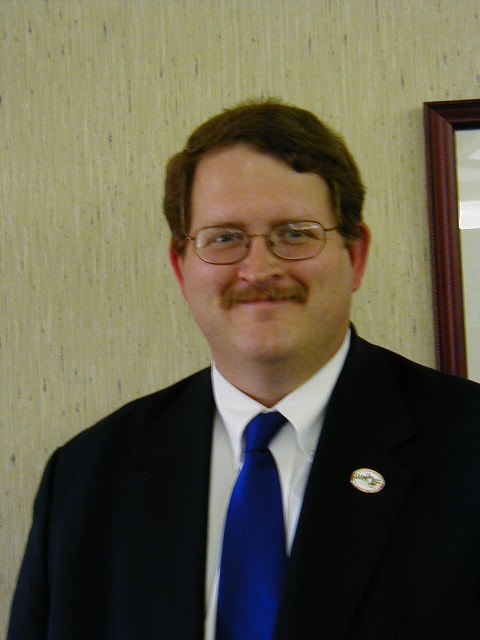
Hal Young Posted by Hello