I had a call from home during the break so came into Scott Brown's breakout session already in progress. He was teaching from the life of Gideon about the church's need to embrace this reformation in family/church relations.
The wickedness that Gideon confronted in Judges was nothing different that what is happening on MTV, with lewdness, godlessness, profanity -- nothing different that what we see today. And then Gideon touched the idol.
Scott said we have a number of idols of our own in the American church. He listed "church growth", tradition, support for public schools, and numerous church programs. "The idols are inside us," he warned.
Reformers, he said, experience tenstion and collateral problems. "There is always a backlash when you confront your father's idol. People feel threatened," he said, when their closely held but unbiblical traditions are challenged.
Reformers sometime suffer family problems when they confront particular idols. Jonathan Edwards experienced this in 1750 when family members worked against him for challenging “the half-way covenant”, and his congregation voted 230-30 to remove him from his decades-long tenure at the Northampton church. Scott read a long and touching quote from Edwards' farewell sermon, concluding:
“The minister may be removed to a distant place and they may never have any more to do with one another in this world. But if it be so, there is one meeting more that they must have, and that is in the last great day of accounts.” -- Jonathan Edwards, July 1, 1750
Times of reformation are times of testing; we need to understand clearly the laws of the tongue, of loving one another, of being transformed by the renewing of our minds, to repay no one evil for evil, [and] if it is possible, "as much as it depends on you, be at peace with all men.” In times of reformation, there may be many unforeseen circumstances in families, churches, and nations.
We can look back on surprising methods God uses to get His work done, such as reducing Gideon's army from 32 thousand to 300. It is hard to realize how important we are individually in this process. God is able to work mightily through small groups of people. “Not by might and not by power, but by My Spirit, says the Lord God of hosts.”
We can observe the miracle of God's help in the midst of the conflict. Gideon's strategy was questionable but God desired to work wonders.
We have to admit that the reformations do not last very long, such as chapter 8 shows. “So it was, as soon as Gideon was dead, that the children of Israel again played the harlot with the Baals ...”
Scott said, "In every reformation, the next generation falls off the wagon. The secret to revival is for fathers to rise up and equip the next generation, or the reformation will not survive his death. The role of the father is critical to the continuing of the revival into the next generation.”
We need to identify the reforms that we are convinced of. What are the key reformations that are important for our day, and why should we be faithful to fulfill them?
= The core reformation is the father who will overcome all obstacles to draw his family together as a church. We may find similar oppositions to this reformation [as Gideon did].
= An understanding and a practical belief in the doctrine of the sufficiency of Scripture ... that all of life shall be governed and regulated by the life-giving stream of Scripture. We need the reforming ministry of God so we don't find ourselves wickedly angry with one another because we are only doing “all that we know”. The church desperately needs a refresher course in the sufficiency of Scripture, and from that, expository preaching.
= A defense of the creation order doctrines, which are under serious attack. The biblical doctrines of manhood and womanhood, marriage, sexuality. Why are they so attacked? Because they are the foundation of the delivery system of the Gospel
= A return to Biblical educational philosophy. Most people are not aware that what we do today, and have done for 150 years, departs from the Biblical model – which is to say, the Biblical content, the method (real world experience under the supervision of fathers), the objective (character growth), delivery (parents), location (home), context (age-integrated, not segregated).
= Admit a major driving force for a rolling trans-generational reformation is the influence of a father in his household. When Joshua and Gideon died, and will happen if we neglect this great calling?
"The work of a father is really for one purpose, to present to God at the end of the age millions who will enter his presence with exceding great joy.”
Friday, October 06, 2006


Doug Phillips: "A new vision for an old path"
Doug Phillips' presentation had the lengthy title, “Semper Reformanda: The reformation heritage of the movement to restore family and church to their complementary jurisdictions”
This is not to introduce new doctrine or say that the truths of the past need changing, but to say that we are fallible and need housekeeping in our brains. Christians should be always reforming as we seek to become more consistent to the Word of God.
“We are not revolutionaries but reformers, not taking a new path but an ancient path. Let's take the truth that has always been there and apply it.
“I regret that we don't have all day to talk about the Puritans. I consider myself a neopuritan, and we are essentially a neopuritan work, with neopuritan sympathies, not “puritanism” but in a common adherence to the sufficiency of the Scripture. From that tradition we have the United States of America. The founders especially at Plymouth made the same arguments in the same debate that we are today.
“Suppose a nation in some distant region should take the Bible for their only law book and every member should regulate his conduct by the precepts there exhibited ! What a Utopia; what a paradise would this region be!” -- John Adams
The Bible speaks to every aspect of life. This is the debate between Anglicanism and Puritanism, between the Reformation and Catholicism. Thomas Aquinas the Scholastic believed reason was not impaired by the fall and therefore was reliable for deriving secular issues; the Reformers said man's mind is tainted by his sin. William Blackstone's commentaries on the laws of England said that “the laws of general revelation are not sufficient to teach us to govern ourselves, and therefore God has given us a special revelation”, the Bible, and the rules of common law are based on the Pentateuch (and incorporated twice into the Constitution).
Church leaders are not comfortable with the idea of applying this kind of standard.
We have swear words in Christianity, don't we. They are designed as ad hominem arguments to neutralize the opponents. Just ban them as Legalist or Pharisee, so we don't have to discuss the issues they raise. We live in a culture of gossip and slander, and Christians are kings at this.
History is informative of the work of God over time. How can we be informed by the labors of those who have gone before? We care about history, but the Bible is our final stand. What history shows us is that modern evangelical Christianity is full of the traditions of man that have no Biblical foundation. The church today is largely the result of MTV culture, so that even lukewarm John Adams is seen as a right-wing radical legalistic theonomic Pharisee by the average pastor.
2 Tim 3:16-17 is a watershed passage for our fathers in the faith. If this is true, we're going to be living differently. He referenced the French Reformers Confession of Faith of 1599 on the primacy of Scripture [It might be findable by a search on “examined, regulated, and reformed according to them”]
When push came to shove, the Anglicans' view on vestments was if it wasn't expressly forbidden, it was expressly allowed.
Matt 15:3 – Why do you transgress for the sake of your tradition?
Caution of the tendency to a Talmudic attitude, but compare Christ's teaching that the principle of the matter – adultery in the mind – and the apostle's teaching about muzzled oxen with respect to compensating pastors. “Won't you look beyond this husk and look to the heart of the matter?”
“The movement to bring unity to church and home has its roots in the reformation as embraced by the Puritan tradition.
The theological conflict between the opponents and proponents of family integrated churches is the same theological which characterized the tension between the Church of England and the Puritans, Separatists, and Independents and Presbyterians of the 17th Century.”
Key issues of the Reformation: Key Issues Today
= Does the Bible speak to everything, and if not, what standard do we apply?
It is fallacious to say the because we don't see it mentioned in Scripture, we then have an ethics-free zone to live in. This is the hermeneutic today; where the Anglicans and Catholics said the Bible did not speak to everything, the Puritans said the Bible does speak principially to every issue.
= If something is not expressly forbidden in the Bible, it is expressly allowed?
= Are we free to introduce into worship traditions and practices not found in Scripture? He calls Finney and others “deleterious” in their influence on the modern church's marketing approach and “theology by statistics”. “It doesn't bother me that Christians disagree on what the Bible says, but that we disagree on what the authority is going to be, that bothers me a lot.” People died and the Pilgrims immigrated to avoid requirements to add non-Biblical traditions. Does it sound funny that America was founded by people didn't want to celebrate holidays or make the sign of the cross in worship?
Elements of the Reformation Movement
= Their doctrine was timely and confessional. They spoke to the issues of the day; Richard Baxter, for example, wrote against bear-baiting.
= Their preaching emphasized orthodoxy and orthopraxy.
= Their message and lifestyle prioritized holiness. They were the butt of jokes and mocking, and are today, because of this standard. Modern evangelical Christianity has obliterated the concept of holiness by making everything “holy”, or rather, as “neutral” such that we can take part. John Bunyan wrote against women's fashions of the day as exposing too much at the neckline.
= They had a high regard for the entire law-word of God and saw its applicability to issues as diverse as gambling to the rules of procedure to be employed by the civil magistrate. They dealt with so many of these issues 400 years ago, but men who quote Calvin in the pulpit would never read what he wrote on birth control, for example.
= The blessing of men like Calvin and William Bradford comes from their hermeneutics, even if we disagree on their application.
= They were sacrificial visionaries who emphasized covenant keeping and multi-generational faithfulness.
Sharper Iron . Com has officially pronounced an anathema on the family integrated church movement as false teaching that Christians should have nothing to do with. “I have compassion for our fundamentalist brethren and for anyone who is caught up in the whirlwind of pop culture; I don't think we need to be burning bridges but winning our friends. Homeschoolers experienced persecution from the government and more from the church; they simply out-blessed their critics. Ten years later “Maybe we don't like them, but maybe we can sell them books.”
"One of the greatest things that could happen would be if the death- and youth-obsessed culture imploded so we all went back to basics." Bradford and the Pilgrims chose to move into the land of natives who tortured their captives rather than compromise themselves to stay in England. We don't understand true persecution and commitment in the face of it.
= Their worship was regulative. Anything that was substantive to the worship of God, if it wasn't spoken and given, was not done. The Bible speaks to that and no man may alter that. No Sunday Schools, no nurseries, and their children sat with them sometimes for as long as three hours.
= They appealed to youth but not to youth culture. They wrote and spoke to the youth but spoke to them as adults, not as Veggie Tales-kids who couldn't handle the truth of God's word. They understood we are raising warriors for God and the way they thought and spoke was critical.
Samuel Willard (1682) “[You] will be unworthy heirs of your fathers' estates if you do not prosecute their begun designs.” He quoted six propositions of Thomas Cartwright 1571.
= Puritans were persecuted by execution, banishment, and acts of uniformity.
He outlined the Reformation heritage of training children, that the fathers are responsible, truth is not to be dumbed down, and parents are commanded to procreate.
If the Scriptural patterns, precepts, and principles all point to children with parents in the meeting of the church, what then is the argument for banning them from worship? He cited the London Baptist Confession marriage and polygamy, noting that none of the passages referenced specifically command not to take multiple wives; therefore, may preachers preach against polygamy? There's no explicit command forbidding it! But didn't God give us the positive pattern of how is should be, and examples of the foolishness of men who violated that principle? But you can't use that argument if you follow the pattern of Sharper Iron and others in their camp.
Doug took a few minutes to unleash the heavy guns in the debate of Reformation and birth control. “I need to show this to you; I want you to understand the next time you read some huge tome about the 'baby machines' and the rise of homeschoolers, we are a bunch of moderates compared to our forefathers.”
He included Martin Luther's famous comment starting “The purpose of marriage is not pleasure ... they despise the blessing of God, the Author of marriage.” This can probably be easily found online. He then went to a lengthy commentary by Calvin on the sin of Onan, who called it “an unforgiveable crime”. After a brief citation of Augustine against the Manichean perversion of marriage, he returned to Luther calling Onan “a malicious and incorrigible scoundrel” and his actions “a Sodomitic sin.” Heavy guns indeed.
“I want you to understand something. Many Christians are doing things that involve abortifacient potential; I wonder if, when Jesus says 'of such is the kingdom of heaven', does that include the millions who have died because of pastors and Christian who are practicing these things because they follow the pop culture” and look down on those who seek to hold the Biblical standard. See Vision Forum's position on fruitfulness on “The Tenets of Biblical Patriarchy”.
He wrapped up with a common topic among pastors of our acquaintance, gossip. Several prominent men in the past year have been seriously slandered online, impacting families, ministries, and reputations. “Let each of us be convicted on how we manage our tongues. The Reformers, largely speaking, defended their positions but did not use ad hominem arguments. They used strong language but great amounts of charity.” He quoted the Westminster Catechism, Q.145 on the ninth commandment. “Receiving evil reports is a violation. If you frequent websites that feature reviling and gossip, you are violating the Ninth Commandment if you receive these things.”
A new vision for an old path – not family idolatry, but going back to the Bible and living the way He tells us.
This is not to introduce new doctrine or say that the truths of the past need changing, but to say that we are fallible and need housekeeping in our brains. Christians should be always reforming as we seek to become more consistent to the Word of God.
“We are not revolutionaries but reformers, not taking a new path but an ancient path. Let's take the truth that has always been there and apply it.
“I regret that we don't have all day to talk about the Puritans. I consider myself a neopuritan, and we are essentially a neopuritan work, with neopuritan sympathies, not “puritanism” but in a common adherence to the sufficiency of the Scripture. From that tradition we have the United States of America. The founders especially at Plymouth made the same arguments in the same debate that we are today.
“Suppose a nation in some distant region should take the Bible for their only law book and every member should regulate his conduct by the precepts there exhibited ! What a Utopia; what a paradise would this region be!” -- John Adams
The Bible speaks to every aspect of life. This is the debate between Anglicanism and Puritanism, between the Reformation and Catholicism. Thomas Aquinas the Scholastic believed reason was not impaired by the fall and therefore was reliable for deriving secular issues; the Reformers said man's mind is tainted by his sin. William Blackstone's commentaries on the laws of England said that “the laws of general revelation are not sufficient to teach us to govern ourselves, and therefore God has given us a special revelation”, the Bible, and the rules of common law are based on the Pentateuch (and incorporated twice into the Constitution).
Church leaders are not comfortable with the idea of applying this kind of standard.
We have swear words in Christianity, don't we. They are designed as ad hominem arguments to neutralize the opponents. Just ban them as Legalist or Pharisee, so we don't have to discuss the issues they raise. We live in a culture of gossip and slander, and Christians are kings at this.
History is informative of the work of God over time. How can we be informed by the labors of those who have gone before? We care about history, but the Bible is our final stand. What history shows us is that modern evangelical Christianity is full of the traditions of man that have no Biblical foundation. The church today is largely the result of MTV culture, so that even lukewarm John Adams is seen as a right-wing radical legalistic theonomic Pharisee by the average pastor.
2 Tim 3:16-17 is a watershed passage for our fathers in the faith. If this is true, we're going to be living differently. He referenced the French Reformers Confession of Faith of 1599 on the primacy of Scripture [It might be findable by a search on “examined, regulated, and reformed according to them”]
When push came to shove, the Anglicans' view on vestments was if it wasn't expressly forbidden, it was expressly allowed.
Matt 15:3 – Why do you transgress for the sake of your tradition?
Caution of the tendency to a Talmudic attitude, but compare Christ's teaching that the principle of the matter – adultery in the mind – and the apostle's teaching about muzzled oxen with respect to compensating pastors. “Won't you look beyond this husk and look to the heart of the matter?”
“The movement to bring unity to church and home has its roots in the reformation as embraced by the Puritan tradition.
The theological conflict between the opponents and proponents of family integrated churches is the same theological which characterized the tension between the Church of England and the Puritans, Separatists, and Independents and Presbyterians of the 17th Century.”
Key issues of the Reformation: Key Issues Today
= Does the Bible speak to everything, and if not, what standard do we apply?
It is fallacious to say the because we don't see it mentioned in Scripture, we then have an ethics-free zone to live in. This is the hermeneutic today; where the Anglicans and Catholics said the Bible did not speak to everything, the Puritans said the Bible does speak principially to every issue.
= If something is not expressly forbidden in the Bible, it is expressly allowed?
= Are we free to introduce into worship traditions and practices not found in Scripture? He calls Finney and others “deleterious” in their influence on the modern church's marketing approach and “theology by statistics”. “It doesn't bother me that Christians disagree on what the Bible says, but that we disagree on what the authority is going to be, that bothers me a lot.” People died and the Pilgrims immigrated to avoid requirements to add non-Biblical traditions. Does it sound funny that America was founded by people didn't want to celebrate holidays or make the sign of the cross in worship?
Elements of the Reformation Movement
= Their doctrine was timely and confessional. They spoke to the issues of the day; Richard Baxter, for example, wrote against bear-baiting.
= Their preaching emphasized orthodoxy and orthopraxy.
= Their message and lifestyle prioritized holiness. They were the butt of jokes and mocking, and are today, because of this standard. Modern evangelical Christianity has obliterated the concept of holiness by making everything “holy”, or rather, as “neutral” such that we can take part. John Bunyan wrote against women's fashions of the day as exposing too much at the neckline.
= They had a high regard for the entire law-word of God and saw its applicability to issues as diverse as gambling to the rules of procedure to be employed by the civil magistrate. They dealt with so many of these issues 400 years ago, but men who quote Calvin in the pulpit would never read what he wrote on birth control, for example.
= The blessing of men like Calvin and William Bradford comes from their hermeneutics, even if we disagree on their application.
= They were sacrificial visionaries who emphasized covenant keeping and multi-generational faithfulness.
Sharper Iron . Com has officially pronounced an anathema on the family integrated church movement as false teaching that Christians should have nothing to do with. “I have compassion for our fundamentalist brethren and for anyone who is caught up in the whirlwind of pop culture; I don't think we need to be burning bridges but winning our friends. Homeschoolers experienced persecution from the government and more from the church; they simply out-blessed their critics. Ten years later “Maybe we don't like them, but maybe we can sell them books.”
"One of the greatest things that could happen would be if the death- and youth-obsessed culture imploded so we all went back to basics." Bradford and the Pilgrims chose to move into the land of natives who tortured their captives rather than compromise themselves to stay in England. We don't understand true persecution and commitment in the face of it.
= Their worship was regulative. Anything that was substantive to the worship of God, if it wasn't spoken and given, was not done. The Bible speaks to that and no man may alter that. No Sunday Schools, no nurseries, and their children sat with them sometimes for as long as three hours.
= They appealed to youth but not to youth culture. They wrote and spoke to the youth but spoke to them as adults, not as Veggie Tales-kids who couldn't handle the truth of God's word. They understood we are raising warriors for God and the way they thought and spoke was critical.
Samuel Willard (1682) “[You] will be unworthy heirs of your fathers' estates if you do not prosecute their begun designs.” He quoted six propositions of Thomas Cartwright 1571.
= Puritans were persecuted by execution, banishment, and acts of uniformity.
He outlined the Reformation heritage of training children, that the fathers are responsible, truth is not to be dumbed down, and parents are commanded to procreate.
If the Scriptural patterns, precepts, and principles all point to children with parents in the meeting of the church, what then is the argument for banning them from worship? He cited the London Baptist Confession marriage and polygamy, noting that none of the passages referenced specifically command not to take multiple wives; therefore, may preachers preach against polygamy? There's no explicit command forbidding it! But didn't God give us the positive pattern of how is should be, and examples of the foolishness of men who violated that principle? But you can't use that argument if you follow the pattern of Sharper Iron and others in their camp.
Doug took a few minutes to unleash the heavy guns in the debate of Reformation and birth control. “I need to show this to you; I want you to understand the next time you read some huge tome about the 'baby machines' and the rise of homeschoolers, we are a bunch of moderates compared to our forefathers.”
He included Martin Luther's famous comment starting “The purpose of marriage is not pleasure ... they despise the blessing of God, the Author of marriage.” This can probably be easily found online. He then went to a lengthy commentary by Calvin on the sin of Onan, who called it “an unforgiveable crime”. After a brief citation of Augustine against the Manichean perversion of marriage, he returned to Luther calling Onan “a malicious and incorrigible scoundrel” and his actions “a Sodomitic sin.” Heavy guns indeed.
“I want you to understand something. Many Christians are doing things that involve abortifacient potential; I wonder if, when Jesus says 'of such is the kingdom of heaven', does that include the millions who have died because of pastors and Christian who are practicing these things because they follow the pop culture” and look down on those who seek to hold the Biblical standard. See Vision Forum's position on fruitfulness on “The Tenets of Biblical Patriarchy”.
He wrapped up with a common topic among pastors of our acquaintance, gossip. Several prominent men in the past year have been seriously slandered online, impacting families, ministries, and reputations. “Let each of us be convicted on how we manage our tongues. The Reformers, largely speaking, defended their positions but did not use ad hominem arguments. They used strong language but great amounts of charity.” He quoted the Westminster Catechism, Q.145 on the ninth commandment. “Receiving evil reports is a violation. If you frequent websites that feature reviling and gossip, you are violating the Ninth Commandment if you receive these things.”
A new vision for an old path – not family idolatry, but going back to the Bible and living the way He tells us.
Between sessions
Just a note -- Scott Brown took a moment to introduce me to Arnold Pent as a homeschool leader who has taken a plunge into the cold water of the entrepreneurial pool (I'd say it's not cold, it's refreshing); I had a nice but necessarily brief talk with Arnold and got him to inscribe his book, Ten P's In A Pod, which we read as a family last year.
I also had a moment to talk with Kevin Swanson, the executive director of the Christian Home Educators of Colorado, another excellent writer and speaker.
I need a minute more on my notes from Doug Phillips' presentation but those should be up shortly.
I also had a moment to talk with Kevin Swanson, the executive director of the Christian Home Educators of Colorado, another excellent writer and speaker.
I need a minute more on my notes from Doug Phillips' presentation but those should be up shortly.
Alexander Strauch on Biblical Eldership
Praise to the Lord, who doth prosper thy work and defend thee;
Surely His goodness and mercy here daily attend thee!
Ponder anew what the Almighty can do
if with His love He befriend thee!
We opened this morning with song and Scott Brown pointed out the verse above as especially meaningful in his own life. Certainly I concur. I haven't heard the official number yet but we're sitting in the Crystal Ballroom with about 400 people, not just the men of the church but a number of their wives and not a few children. I don't know if there is any program for the youngest present, though.
Alexander Strauch is speaking this morning. Scott Brown is introducing him and his book, Biblical Eldership. “This has become the seminal work on church leadership. It is a timeless book because it is a collection of expositions of Scripture, nothing fancy but the beautiful, sweet words of Scripture,” says Scott. He says this book has sold something more than 250,000 copies since publication in the 1980's; “It has been a wonderful correction in the life of the church,” he says.
Strauch recommends two books: Agape Leadership on the life of Robert Chapman, the spiritual mentor for George Mueller and the first trustee of Hudson Taylor's China Inland Mission. Spurgeon called him “the saintliest man” he knew. The second book was given to us at check-in, Leading with Love, Strauch's own.
The opening Scripture is Titus 1:5-10 on Paul's view of elders and church order.
The essential nature of having elders who are properly qualified. “[Paul] would say this is a problem in many churches today.”
Strauch said when he was a student at a Baptist seminary some decades ago, the professor lectured on church polity without referencing Scripture. When he asked why, Strauch said he was told all those passages in Paul were just “proof texting” and not relevant.
Many churches have people called “elders” but many are not Biblical elders. The Board Concept is common – elders are elected laymen and not expected to be qualified nor permanent leaders.
“Reformation, revitalization, and recovery of doctrine is an unending task for God's people” he says.
“In every generation, we need an enlightened purification of our tradition; the cry of the Reformation is semper reformanda. The church is always being reformed.” -- R.S. Lewis
John Robinson writing for the Separatists on their departure from Holland deplored Reformed churches who have not moved beyond their reformers – Lutherans who stopped growing with Luther, Calvinists who never go further than Calvin, and so on.
The churches established by the apostles are always examples for the modern church. Further, the New Testament teaches and models plurality of elders and pastoral eldership.
OT witnessed plurity of elders. “It is not a new and subversive doctrine invented by John McArthur twenty-five years ago.” There are elders around the very throne of God. It is the background to the NT
Jesus Christ established eldership for His church. He did not appoint a single man to head the church but appointed twelve and then trained them as a team. He singled out three for particular ministry and leadership; “[And] They were not twelve long-stemmed roses,” he says.
New Testament elders are more defined than their Old Testament counterparts. Further, there is more in the New Testament about elders than about the Lord's Supper, baptism, the Lord's Day, or spiritual gifts. The NT gives us Examples of elder-led churches, Instruction to churches about eldes, Instruction and exhortation directly to elders (Acts 20, 1 Peter 5), and the apostolic direction to elders to “set in order” and correct deficiencies in the church.
“Why do we have elders? Because the Bible says so.” A mission professor who was reprimanded for using Biblical Eldership in classes when it didn't include women in that role said, “It's not the author's fault; look at the title.”
Elders promote the true nature of the church. The structure of government you give the local church makes a profound statement about the body, and it is important. Why? Because the church is a close-knit family and household -- 1 Tim 3.15. The church is a humble, serving community. Luke 22.26f. Humility, servant hood, and love is modeled by shared leadership.
Mt 18.20 The church is under the headship of Christ. “This was very real to the early church.”
And it promotes the protection and accountability of leaders. “Our theology tells us man has been ruined by sin.” Jer 17.9 says the heart is desperately sick. “You need accountability and community.”
Defining and understanding New Testament Christian eldership
The general NT concept is pastoral oversight, not board eldership or lay eldership. They shepherd the church.
There is one very confusing subject in many churches ... equality and diversity within the eldership. It's taught in the four gospels even before the Epistles. The church is built on the apostolic body and authority selected by Christ. Not Peter and the associate apostles – all equally called to go out in Christ's name. But no question Christ also picked Peter to strengthen his brethren.
Look at 1 Tim 5 (Cf. Acts 20) – Paul charged the Ephesian elders to guard the church. The church's great enemy is false teachers. Five years later he returns to Ephesus and finds false teaching rampant, excommunicates two men (see 1 Tim 1) and leaves Timothy behind to take action, sending a letter of instruction and authorization to him later. The best remedy for false teaching is good teaching.
“Sermonettes produce Christianettes.”
Those who work hard, to the point of weariness, in preaching and teaching. Among the elders, not every is gifted as a teacher but every one must be able to teach. Some rule well, some are laborers, some are due double honor for their diligence in study and exhortation. The church must take care of them, not be jealous of them, because they will grow the church. All share the same charge but not all are similarly gifted. There is equality and diversity, the Biblical pattern from both Christ and Paul.
“What a beautiful system of government that allows all men who have desire and qualification to take part in the government with their particular giftedness being recognized.”
Surely His goodness and mercy here daily attend thee!
Ponder anew what the Almighty can do
if with His love He befriend thee!
We opened this morning with song and Scott Brown pointed out the verse above as especially meaningful in his own life. Certainly I concur. I haven't heard the official number yet but we're sitting in the Crystal Ballroom with about 400 people, not just the men of the church but a number of their wives and not a few children. I don't know if there is any program for the youngest present, though.
Alexander Strauch is speaking this morning. Scott Brown is introducing him and his book, Biblical Eldership. “This has become the seminal work on church leadership. It is a timeless book because it is a collection of expositions of Scripture, nothing fancy but the beautiful, sweet words of Scripture,” says Scott. He says this book has sold something more than 250,000 copies since publication in the 1980's; “It has been a wonderful correction in the life of the church,” he says.
Strauch recommends two books: Agape Leadership on the life of Robert Chapman, the spiritual mentor for George Mueller and the first trustee of Hudson Taylor's China Inland Mission. Spurgeon called him “the saintliest man” he knew. The second book was given to us at check-in, Leading with Love, Strauch's own.
The opening Scripture is Titus 1:5-10 on Paul's view of elders and church order.
The essential nature of having elders who are properly qualified. “[Paul] would say this is a problem in many churches today.”
Strauch said when he was a student at a Baptist seminary some decades ago, the professor lectured on church polity without referencing Scripture. When he asked why, Strauch said he was told all those passages in Paul were just “proof texting” and not relevant.
Many churches have people called “elders” but many are not Biblical elders. The Board Concept is common – elders are elected laymen and not expected to be qualified nor permanent leaders.
“Reformation, revitalization, and recovery of doctrine is an unending task for God's people” he says.
“In every generation, we need an enlightened purification of our tradition; the cry of the Reformation is semper reformanda. The church is always being reformed.” -- R.S. Lewis
John Robinson writing for the Separatists on their departure from Holland deplored Reformed churches who have not moved beyond their reformers – Lutherans who stopped growing with Luther, Calvinists who never go further than Calvin, and so on.
The churches established by the apostles are always examples for the modern church. Further, the New Testament teaches and models plurality of elders and pastoral eldership.
OT witnessed plurity of elders. “It is not a new and subversive doctrine invented by John McArthur twenty-five years ago.” There are elders around the very throne of God. It is the background to the NT
Jesus Christ established eldership for His church. He did not appoint a single man to head the church but appointed twelve and then trained them as a team. He singled out three for particular ministry and leadership; “[And] They were not twelve long-stemmed roses,” he says.
New Testament elders are more defined than their Old Testament counterparts. Further, there is more in the New Testament about elders than about the Lord's Supper, baptism, the Lord's Day, or spiritual gifts. The NT gives us Examples of elder-led churches, Instruction to churches about eldes, Instruction and exhortation directly to elders (Acts 20, 1 Peter 5), and the apostolic direction to elders to “set in order” and correct deficiencies in the church.
“Why do we have elders? Because the Bible says so.” A mission professor who was reprimanded for using Biblical Eldership in classes when it didn't include women in that role said, “It's not the author's fault; look at the title.”
Elders promote the true nature of the church. The structure of government you give the local church makes a profound statement about the body, and it is important. Why? Because the church is a close-knit family and household -- 1 Tim 3.15. The church is a humble, serving community. Luke 22.26f. Humility, servant hood, and love is modeled by shared leadership.
Mt 18.20 The church is under the headship of Christ. “This was very real to the early church.”
And it promotes the protection and accountability of leaders. “Our theology tells us man has been ruined by sin.” Jer 17.9 says the heart is desperately sick. “You need accountability and community.”
Defining and understanding New Testament Christian eldership
The general NT concept is pastoral oversight, not board eldership or lay eldership. They shepherd the church.
There is one very confusing subject in many churches ... equality and diversity within the eldership. It's taught in the four gospels even before the Epistles. The church is built on the apostolic body and authority selected by Christ. Not Peter and the associate apostles – all equally called to go out in Christ's name. But no question Christ also picked Peter to strengthen his brethren.
Look at 1 Tim 5 (Cf. Acts 20) – Paul charged the Ephesian elders to guard the church. The church's great enemy is false teachers. Five years later he returns to Ephesus and finds false teaching rampant, excommunicates two men (see 1 Tim 1) and leaves Timothy behind to take action, sending a letter of instruction and authorization to him later. The best remedy for false teaching is good teaching.
“Sermonettes produce Christianettes.”
Those who work hard, to the point of weariness, in preaching and teaching. Among the elders, not every is gifted as a teacher but every one must be able to teach. Some rule well, some are laborers, some are due double honor for their diligence in study and exhortation. The church must take care of them, not be jealous of them, because they will grow the church. All share the same charge but not all are similarly gifted. There is equality and diversity, the Biblical pattern from both Christ and Paul.
“What a beautiful system of government that allows all men who have desire and qualification to take part in the government with their particular giftedness being recognized.”
Uniting Church and Family
This morning I'm at the Uniting Church & Family Conference at the Crowne Plaza Hotel in St. Louis. This is a national event sponsored by the National Center for Family-Integrated Churches, a ministry of Vision Forum headed by my friend Scott Brown. Thirteen of us from North and South Carolina rode up in Jason Dohm's 15-passenger van yesterday -- 1008 miles in 18 hours -- and while we weren't able to make the opening session last night, we're in place this morning.
I'm going to take a shot at blogging through the day -- partly so others can benefit from what we're hearing, and partly because I'm lazy and don't want to go back afterwards and type up my notes later.
Voddie Baucham and Scott Brown have walked in, along with Jeff Pollard, so I'm going to go say hi before we get started.
I'm going to take a shot at blogging through the day -- partly so others can benefit from what we're hearing, and partly because I'm lazy and don't want to go back afterwards and type up my notes later.
Voddie Baucham and Scott Brown have walked in, along with Jeff Pollard, so I'm going to go say hi before we get started.
But, Sir
A man came down to the front desk at the hotel to complain.
"I turned the handle marked 'C' and got scalding hot water," he said.
"But, monsieur," said the clerk, "this is Montreal! To us, 'C' means chaud. It is French for 'hot'."
"I know that," said the guest, "but the other handle was marked 'C', too."
"Ah. But, monsieur," said the clerk, "you see, in Montreal, we are bilingual."
[Not original to me, but I was reminded of it in the shower this morning.]
"I turned the handle marked 'C' and got scalding hot water," he said.
"But, monsieur," said the clerk, "this is Montreal! To us, 'C' means chaud. It is French for 'hot'."
"I know that," said the guest, "but the other handle was marked 'C', too."
"Ah. But, monsieur," said the clerk, "you see, in Montreal, we are bilingual."
[Not original to me, but I was reminded of it in the shower this morning.]
Saturday, September 30, 2006
A visit to great-great-great-great-grandpa
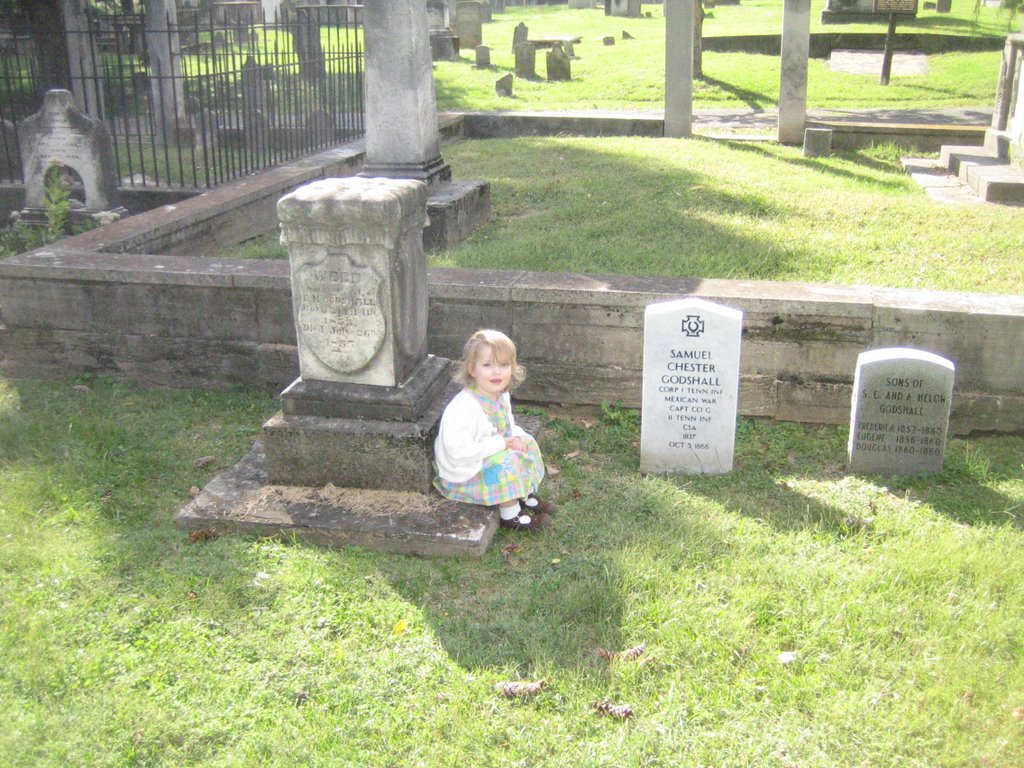
It's not often you have the opportunity to visit the grave of your great-great-great-great-grandfather. In my North Carolina family, a lot of the graves were marked with uncut slabs of rock, if at all. From the small bit of information I've uncovered, this grave had even less marking other than the tradition that he was buried next to his four-month-old son Webb in the old Nashville City Cemetery, Nashville, Tennessee.
Susannah is sitting on the child's marker, and just to the right is the new (2005) headstone for Samuel Chester Godshall, Captain, Co. G, 11th Tennessee Infantry, the great grandfather of her great grandmother.
The smaller marker has the names of three Godshall children who died in the same year, 1860, presumably of some illness or disaster. What the marker doesn't show is one of the more interesting names to appear in the family tree -- "A.H." is Captain Godshall's wife, Aramathea Helon Webb (listed as Aramathea in the 1860 census and Helon in the 1880, when she was living with her bachelor brother John C. Webb and her widowed sister).
Friday, September 22, 2006
Okay, I know it's stupid
... but I'll admit to it anyway.
While working on a month-long project out of town (and, not incidentally, on an expense account), I took advantage of a small storefront Chinese restaurant a few blocks from the hotel.* Just for fun, I always make it a point to eat Chinese food with chopsticks, as it was intended, and try to ask for them in Mandarin (Duì bù qì -- gěi wo kuài zi?). I'll confess, I'm not much good with rice, so I'll cheat and use the fork for that.
Unfortunately, eating Chinese four or five times in two weeks wore a groove in the cultural processor in my brain. One evening, I ran across a Greek restaurant** and settled in for another exotic meal ... and all the time, my brain was saying, "Chopsticks ... need chopsticks ..."
Apparently it couldn't deal with "Greek" and settled for "foreign".
=====
* If you're interested, it's the Shuang Xi Kitchen in North Charleston, SC, just off Montague Avenue and near the airport ... it's good, too.
** This was the Zeus Grill and Seafood in Mount Pleasant; it is tucked in behind some crepe myrtles so it's hard to see from the highway, US 17, but it adjoins the parking lot for the Outback Steakhouse. It was really good, and I highly recommend the lemon chicken soup.
While working on a month-long project out of town (and, not incidentally, on an expense account), I took advantage of a small storefront Chinese restaurant a few blocks from the hotel.* Just for fun, I always make it a point to eat Chinese food with chopsticks, as it was intended, and try to ask for them in Mandarin (Duì bù qì -- gěi wo kuài zi?). I'll confess, I'm not much good with rice, so I'll cheat and use the fork for that.
Unfortunately, eating Chinese four or five times in two weeks wore a groove in the cultural processor in my brain. One evening, I ran across a Greek restaurant** and settled in for another exotic meal ... and all the time, my brain was saying, "Chopsticks ... need chopsticks ..."
Apparently it couldn't deal with "Greek" and settled for "foreign".
=====
* If you're interested, it's the Shuang Xi Kitchen in North Charleston, SC, just off Montague Avenue and near the airport ... it's good, too.
** This was the Zeus Grill and Seafood in Mount Pleasant; it is tucked in behind some crepe myrtles so it's hard to see from the highway, US 17, but it adjoins the parking lot for the Outback Steakhouse. It was really good, and I highly recommend the lemon chicken soup.
Saturday, September 16, 2006
Is it Gestalt? Or word association?
My first car was a 1960 Volkswagen, but my first "new" car was a used 1981 Ford Escort. I had a lot of fun with it in college, driving it all over the mountains around Clemson and off to court my future wife in Charleston.
At 45,000 it threw the timing belt, a design flaw of the '81 model, and wrecked several valves, forecasting the future for the little two-door. It did this twice more and finally stalled the last time at 83,000 miles. I pushed it home, worked on it for a while, and got a trade-in valuation of $250 when we towed it to the dealership at nine years old.
Though we had decided never to buy another Escort, we were expecting our first child and had one dead car in the driveway and a Datsun/Nissan Sentra starting to show its age as well. It was definitely time to get a more realiable vehicle. As it happened in God's Providence, the best buy was a new, last-year's-overstock 1989 Escort station wagon. Our first brand new vehicle, then, was the second Escort, which was the family Conestoga to California and back. It was our main vehicle until 1996; I installed an after-market seat belt in the back to make it a "five" passenger arrangement. When our first son's feet extended between the front seats, with him in the back and a baby seat on either side of him, we bought our first van.
That Escort developed inexplicable electrical problems the next year, and while waiting at our mechanic's for repair, was swallowed up by Hurricane Floyd's floodwaters. Scrap value at ten years: $36.
Recently my work vehicle, a well-seasoned Chevy Blazer, developed a very disturbing rattle which was diagnosed as a failing piston bearing. Since we have three vehicles at the moment, the Blazer has been sidelined for the time being.
The peculiar thing is that more than once when I've mentioned the Blazer in casual conversation, I said "Escort". Obviously my subconscious mind has permanently associated "defective vehicle" with "Ford Escort"; I suppose that's enevitable when you spent the better part of ten years visiting repair shops in several states. And I can't say it's a Chevrolet mindset, since I'm currently driving a Jeep and have very happy memories of my VW and the Nissan along the way.
Tuesday, September 12, 2006
Never answered
Working on her masters degree from Florida State early in our marriage, my wife had to take a class at the main campus in Tallahassee, a good two hour drive from our home at Tyndall AFB. It was a Saturday morning class, once a week, so we decided it was manageable. On the other hand, the class met at 8:30 a.m. and the drive involved crossing from Central to Eastern time zone, which pushed the start time back an hour more. We had to leave our home near Panama City well before sunup and frankly, some mornings we weren't at our sharpest driving past Wewahitchka and Blountstown in "the howling wilderness of northwest Florida".
I was driving one morning while my wife napped in the other seat, and passing the exit for the town of Quincy, I recalled a short story called, "The Quince Tree". Musing along the two-lane road, I wondered about that tree, which apparently was symbolic and familiar to the (British?) author but a mystery to me. Knowing my wife's bachelors degree was in biology with a good amount of plant taxonomy in the curriculum, I asked, without introduction and bit too loudly, "WHAT IS QUINCE?"
It was a bit startling, I guess. I don't recall her answer, either.
To this day, now eighteen years later, whenever one of us erupts into comment or explodes a question into a still room while reading, the other will typically answer in kind, "WHAT IS QUINCE?" And like the question in Atlas Shrugged, it generally goes unanswered.
Tuesday, August 22, 2006

Hotel Galeria

Part of "Grupo Spiegel", which owns not only a slaughterhouse but also grocery stores, hardware and home improvement stores, a ranchero, and a shopping center next door.
Why the Panama Canal needs to be bigger
 Because the lines waiting to enter at Panama City (the Pacific end) are pretty long.
Monday, August 14, 2006
Back to the graphics shop, please
Wal-Mart usually does much better than this. Seen in the Smithfield/Selma, NC, Walmartgatory, over the photography studio:
"Bubbles -n- Giggles Passport Photos While You Wait".
It comes from trying to use the extra square foot of the banner advertising a new baby picture setup. I'm not going to spend any time trying to picture exactly what a "Bubbles -n- Giggles Passport Photo" might look like.
"Bubbles -n- Giggles Passport Photos While You Wait".
It comes from trying to use the extra square foot of the banner advertising a new baby picture setup. I'm not going to spend any time trying to picture exactly what a "Bubbles -n- Giggles Passport Photo" might look like.
Saturday, August 05, 2006
Just what is an inundated Calvinist?
I've never taken the space to explain the title of this weblog, The Inundated Calvinist. I hit on this name long before blogging was a force, in fact, several years before we had Internet service. There are several facets to it, so when I set up my Blogger account, I decided to finally use the name.
The Calvinist label refers to my doctrinal beliefs, which are conservative, evangelical, and thoroughly in line with the tradition of the Reformation.
The "inundation" refers to a particular expression of that Calvinism; although raised in the Presbyterian church, after a thorough study of the matter in college I became convinced of the "credobaptist" position, that is, baptism administered only to believers, and that by immersion rather than sprinkling. An "inundated Calvinist", then, is a tongue-in-cheek name for a Reformed Baptist believer.
Finally, the "inundation" also refers to my general mode of life; between work, family, and several ministries, I find my days are very, very full. It's not uncommon to sense the water lapping at the gunwhales as I row. Of course, a well-laden boat tends to ride low in the water, so I'm not sure I'm ready to lighten the ship yet.
Monday, July 10, 2006
Article in Carolina Journal Online
My article on the impact of rising energy costs on school systems and an interview with Charlotte-Mecklenburg Schools facilities director Phil Berman, was the lead in the July 3 Carolina Journal Online. Travel, work, and family commitments - not to mention writing for CJ - have kept me from posting recently, but that's the latest on the web.
Wednesday, June 21, 2006
The thing itself
I've tried to post on at least a weekly basis for the past few months, and it's a reflection of the rush of other responsibilities and commitments that I haven't for the past two. Sorry about that.
I did run across this item the other day and thought I might as well put it up. An article in The Tennessean described a debate on Calvinism during last week's annual meeting of the Southern Baptist Convention. I was struck by the Christian tone of both men who honestly wanted to discuss theology, not aim for personal destruction of their opponent. The most regrettable comment, though, came from a Tennessee pastor who will remain nameless:
"I don't get caught up in Calvinism or some of the other issues," said [Nameless], pastor of [Deleted] Baptist Church in [Deleted], Tenn., attending with his wife, [Mrs. Nameless]. "I think our denomination needs to just focus on evangelism, on reaching the world through Christ."
Interesting twist there, reaching the world through Christ, not for Him. What's the purpose here?
But what bothers me is the highlighted comment. Occasionally I hear statements along the lines of, "At our church, we don't care about doctrine, we just love Jesus" -- begging the question what to do about Acts 2:42, for example -- but I expect better reasoning from a pastor. And if Calvinism as defined in the current debate isn't about evangelism, then it's not a debate at all.
I'd have to agree -- Pastor Nameless apparently isn't involved in the issue.
I did run across this item the other day and thought I might as well put it up. An article in The Tennessean described a debate on Calvinism during last week's annual meeting of the Southern Baptist Convention. I was struck by the Christian tone of both men who honestly wanted to discuss theology, not aim for personal destruction of their opponent. The most regrettable comment, though, came from a Tennessee pastor who will remain nameless:
"I don't get caught up in Calvinism or some of the other issues," said [Nameless], pastor of [Deleted] Baptist Church in [Deleted], Tenn., attending with his wife, [Mrs. Nameless]. "I think our denomination needs to just focus on evangelism, on reaching the world through Christ."
Interesting twist there, reaching the world through Christ, not for Him. What's the purpose here?
But what bothers me is the highlighted comment. Occasionally I hear statements along the lines of, "At our church, we don't care about doctrine, we just love Jesus" -- begging the question what to do about Acts 2:42, for example -- but I expect better reasoning from a pastor. And if Calvinism as defined in the current debate isn't about evangelism, then it's not a debate at all.
I'd have to agree -- Pastor Nameless apparently isn't involved in the issue.
Thursday, June 08, 2006
An Automotive Thought
This afternoon I'm dealing with the realization that for every hundred miles we drive in the van, we'll spend $24.45 on the gas, $1.35 on the tires, 42 cents on the oil, and three bucks on the air conditioner.
Anyway, that's about the cost of cool air in our eleven-year-old 15-passenger van, if our mechanic is right.
I'm reminding myself that as long as we're spending less than $400 a month on repairs, we're coming out ahead in the near term.
Monday, June 05, 2006
Worms, I Tell You
Some years ago I read several books on English and American hymnody. It was interesting reading, but it was plain that like so many other areas of American Christianity, there was a definite slide in the content of the hymnbooks during the last century. One writer quoted, humorously he thought, a clergyman colleague's complaint about "vermicular hymns", that is, "hymns with worms in 'em!" We sang one this past Sunday -- in the sanitized version, alas, but remembering Isaac Watts' original --
Alas! And did my Saviour bleed?
And did my Sovereign die?
Would He devote that sacred head
For such a worm as I?
More modern hymnbooks pull the "worm" reference and substitute "sinner", which it still Biblical and no doubt still offends some. Still worse, though, is the bouncing chorus that some cheerful soul added long after Watts reached his reward:
At the cross, at the cross, where I first saw the light
And the burden of my heart rolled away (rolled away)
It was there by faith I received my sight
And now I am happy all the day
It's a catchy chorus, though you could debate whether modern notions of "happy" still mesh with the synonym "blessed" when the chorus was added. It even has good harmony and an interesting bass line, I'll admit, but it's totally inappropriate for the original hymn. Watts concludes his portion with simple pathos:
… dissolve my heart in thankfulness,
and melt mine eyes in tears.
But drops of grief can ne'er repay
The debt of love I owe
Here, Lord, I give myself away
'Tis all that I can do
Look at Watts' vocabulary --
Alas, grieve, bleed, die, worm …
dissolve, melt, tears …
drops of grief, debt, owe, and give myself away.
And the chorus responds:
And now I am happy all the day
I tried singing "blessed" but it just wouldn't fly.
Keep the chorus, if you like, attach to another hymn or develop the idea to stand in its own framework. But as for me, I need to be reminded of my vermicular state, and my helpless dependence on a gracious Savior, and the awful price He paid, daily. Or to borrow the chorus, all the day.
Sunday, May 28, 2006
Conference report
We're back from the North Carolinians for Home Education Conference and on the road to recovery, thanks.
Someone stopped me in the hallway at the conference and asked how I was doing. I told them I was hot, footsore, and full of headache, and wouldn't be anywhere else in the world. All true.
The big personal event was completing my three terms as president of the organization and handing the reins over to my extremely capable "executive officer", Ernie Hodges of Pfafftown. Ernie has been my wing man for the entire three years and I couldn't have asked for one better. I recently read Leading from the Second Chair, a book about how associate pastors, vice presidents, and assistant chairmen can improve their service in the "second chair" positions, and I was thinking the entire time, "Ernie already does this." I'm looking forward to serving under his administration now, and thank him for the support he's given me.
I also had the privilege of speaking to the Friday morning general session, about two thousand homeschoolers in one place, on "the state of homeschooling". The point I wanted to get across is that home education in North Carolina, like Franklin's summation of the Constitution, is a freedom we enjoy only as long as we are careful to keep it. Homeschooling has grown to a population comparable to the city of Fayetteville, and I doubt that we will see a true assault on the basic right to teach our own children at home. What concerns me is the rise of public school programs which offer a home-based instructional program. The educational libertarian in me applauds the development of any alternative system which will allow parents to spend more time and attention on their children's education, saving taxpayers money on school construction and personnel costs to boot; yet we homeschoolers have to remember that a public school program in our living room is not an expression of the parents' right to direct the education of their children.
If our only concern is negative socialization, then keeping our children off the bus and the playground by using a virtual school program may be an adequate solution. If our intent is to train up our children according to our own conscience and best judgment, though, we can't forget that accepting the convenience of public school at home means trading away our independence and freedom to do what we think is right, regardless of the state's largest bureaucracy.
Someone stopped me in the hallway at the conference and asked how I was doing. I told them I was hot, footsore, and full of headache, and wouldn't be anywhere else in the world. All true.
The big personal event was completing my three terms as president of the organization and handing the reins over to my extremely capable "executive officer", Ernie Hodges of Pfafftown. Ernie has been my wing man for the entire three years and I couldn't have asked for one better. I recently read Leading from the Second Chair, a book about how associate pastors, vice presidents, and assistant chairmen can improve their service in the "second chair" positions, and I was thinking the entire time, "Ernie already does this." I'm looking forward to serving under his administration now, and thank him for the support he's given me.
I also had the privilege of speaking to the Friday morning general session, about two thousand homeschoolers in one place, on "the state of homeschooling". The point I wanted to get across is that home education in North Carolina, like Franklin's summation of the Constitution, is a freedom we enjoy only as long as we are careful to keep it. Homeschooling has grown to a population comparable to the city of Fayetteville, and I doubt that we will see a true assault on the basic right to teach our own children at home. What concerns me is the rise of public school programs which offer a home-based instructional program. The educational libertarian in me applauds the development of any alternative system which will allow parents to spend more time and attention on their children's education, saving taxpayers money on school construction and personnel costs to boot; yet we homeschoolers have to remember that a public school program in our living room is not an expression of the parents' right to direct the education of their children.
If our only concern is negative socialization, then keeping our children off the bus and the playground by using a virtual school program may be an adequate solution. If our intent is to train up our children according to our own conscience and best judgment, though, we can't forget that accepting the convenience of public school at home means trading away our independence and freedom to do what we think is right, regardless of the state's largest bureaucracy.
Saturday, May 20, 2006
Speaking at the NCHE Conference
Melanie and I will be speaking at the 22nd Annual Conference and Book Fair sponsored by North Carolinians for Home Education, held at the Benton Convention Center in Winston-Salem, NC, this coming Thursday through Saturday (May 25-27).
Melanie, mother of six boys, will be speaking in the first session on "Ballistic Homeschooling: Teaching and Appreciating Boys"; this is free and open to the public, Thursday at 3:00 p.m.
I will be giving my talk for fathers on "The World, The Flesh, and The Young'uns", Friday at 11:00 a.m.
The two of us will also be giving a session called "You Can Rest When You Get Home", about the unexpected benefits of educational travel as homeschoolers. This will also be Friday, at 2:00 in South Main 3. It's not on the website yet; the speaker originally scheduled for that time had to cancel for family reasons, but we has already been asked to do this session so the opportunity was Providential.
I'll also be giving the President's address at NCHE's Annual Membership Meeting, Saturday at 8:30 a.m., right before the Saturday keynote session.
The full schedule and conference information are on NCHE's website, http://nche.com. Hope we'll see you you there -- stop by and say hello.
Thursday, May 18, 2006
My take on illegal immigration
I've posted a piece this on my op-ed blog, Five Points. First things first, I say.
Something for everyone, I guess
I read this morning that my employer, Progress Energy, is sponsoring a portion of the Raleigh spring festival "Artsplosure" which includes an act called "Guys On Ladders".
How appropriate is that?
Wednesday, May 17, 2006
Brains fully engaged, every day
Paul Brewster writes for Olive Press Online that mothering is not a threat to civilization, but its preservation:
Rearing children and managing a household are first-order jobs. They require the best efforts parents can put forth. Yet [economist Sylvia Ann] Hewlett is alarmed that women who have children sometimes delay their re-entry into the “workforce” for two or more years. She was so concerned with this finding that in 2004 she formed the Hidden Brain Drain Task Force to “try to find solutions everyone could live with.” Everyone, that is, except the children.
So, according to the feminists, mothering is a brain-drain and a threat to civilization. They could not be more wrong. Stay-at-home moms are the hope of civilization and represent the finest and most noble use of human intellect known to humanity. My wife is a summa cum laude college graduate. And she uses her brain fully every day. I believe deeply that her contributions to society are every bit as vital as that of the most strategically positioned female executive. Her brain is not wasted by staying home. Instead, she has chosen to invest her life in our children and in their future.
The truth is that when we married more than 17 years ago, we did not envision her staying at home. But the further we progressed in rearing our family, the more we realized what my mom already knew: parenting and homemaking are not short-term propositions. They require the very best that parents have to offer of both time and energy, and they require it over very long periods of time—like a lifetime.
http://www.sebts.edu/olivepressonline/index.cfm?PgType=2&ArticleID=422
Monday, May 15, 2006
Perhaps St. Paul can speak to Durham
John A. Murray, headmaster of St. David's School in Raleigh, wrote an excellent op-ed in the News & Observer last week, asking whether it wasn't time for colleges, and particularly Duke University, to look to the impact of faith or its lack on students and their communities. He suggests engaging a much older book than those picked for UNC's summer reading program:
While Duke faculty committees continue to explore ways to address recent events, perhaps they should consider reexamining the original tenets of their institution. Former Duke Divinity School professor George Marsden documents the 1924 mission statement in The Soul of the American University: "The Aims of Duke University are to assert a faith in the eternal union of knowledge and religion set forth in the teachings and character of Jesus Christ, the Son of God." As Marsden notes, "Until the 1960s, Duke continued to require undergraduates to take courses in Bible."
Given tensions between Duke and the community of Durham, perhaps incoming freshmen could once again be challenged to read, discuss and debate a thought-provoking work such as the Bible's book of Galatians. Here are found the ideas of knowledge and faith which shaped the principles of our democratic republic: "There is neither Jew nor Greek, slave nor free, male nor female, for you are all one in Christ Jesus" (Galatians 3:28). This is a much-needed reminder as our society faces issues of race, class and gender today.
-- John A. Murray, "College Students Could Do With More Faith", News & Observer 5/9/06
Saturday, May 13, 2006
"Where there is no law there is no freedom."
"The law that was to govern Adam was the same that was to govern all his posterity, the law of reason. But his offspring having another way of entrance into the world, different from him, by a natural birth, that produced them ignorant, and without the use of reason, there were not presently under that law. For nobody can be under a law that is not promulgated to him; and this law being promulgated or made known by reason only, he that is not come to the use of his reason cannot be said to be under this law; and Adam's children being not presently as soon as born under this law of reason, were not presently free. For law, in its true notion, is not so much the limitation as the direction of a free and intelligent agent to his proper interest, and prescribes no father than is fore the general good of those under that law. Could they be happier without it, the law, as a useless thing, would of itself vanish; and that ill deserves the name of confinement which hedges us in only from bogs and precipices. So that however it may be mistaken, the end of law is not abolish or restrain, but to preserve and enlarge freedom. For in all the states of created beings, capable of laws, where there is no law there is no freedom. For liberty is to be free from restraint and violence from others, which cannot be where there is no law; and is not, as we are told, " a liberty for every man to do what he lists." For who could be free, when every other man's humour might domineer over him? But a liberty to dispose and order freely as he lists his person, actions, possessions and his whole property within the allowance of those laws under which he is, and therein not be subject tot he arbitrary will of another, but freely follow his own."
John Locke (1632-1704)
Concerning Civil Government, 57
Why the reform didn't work
"We trained hard, but it seemed every time we were beginning to form up into teams, we would be reorganized. I was to learn later in life that we tend to meet any new situation by reorganizing, and a wonderful method it can be for creating the illusion of progress while producing confusion, inefficiency and demoralization."
From Petronii Arbitri Satyricon A.D. 66
Attributed to Gaius Petronus, Roman General
From Petronii Arbitri Satyricon A.D. 66
Attributed to Gaius Petronus, Roman General
(HT: Terry Stoops, Ph.D)
Thursday, May 11, 2006
A new article and a new weblog
Weblogs run the gamut of online diaries (or diatribes) to serious journalistic vehicles. Like most I read, this is some of both. I have opened up another weblog, Five Points, which I plan to maintain more in the commentary end of the range, while I keep the less journalistic items over here. I've just posted a summary of a book review I wrote for Carolina Journal, considering the life of The Man on the Ten-Dollar Bill.
Comments are open in both locations; feel free to let me know what you think.
Comments are open in both locations; feel free to let me know what you think.
Wednesday, May 10, 2006
The faith of George W
Michael and Jana Novaks have an excellent article in The American Enterprise, "Washington's Faith and the Birth of America".
Almost everything about George Washington was hard-earned, and his faith was no exception. Although he ended up owning a library of nearly 1,000 books, some 40 or so concerning religious questions, his preferred teacher was experience. In his father’s line there was at least one Anglican cleric, and his mother was unusually devout and quite attentive to the religious life of her children. But Washington’s faith mostly grew out of his diligent efforts at self-improvement.
Washington studied the thinking of British generals and European monarchs, the manners of Indian chiefs, the habits of fur trappers of the frontier, good farmers and bad, and trustworthy and untrustworthy merchants. He pondered the ways of Congress and the surges of public sentiment. He watched closely the inner passions of his own fighting men.
He learned how all sorts of humans reason, what they fear, what attracts them, and what moves them to action. Washington was nearly a genius in getting the best out of his own hotly rivalrous cabinet. He had enormous common sense and a wordless instinct for how things actually work in the real world. He understood the dramatics of gesture, raiment, and dress; he understood the role of imagination as well as reason in life, of passion as well as logic. His was not a highly verbal nor academic mind. But his practical judgments were sure.
Washington knew that the tasks he undertook were too big for him, that he was too unlearned and lacked some of the necessary gifts, that the odds he faced were steep. He truly, genuinely, feared failure.
He got nearly his fill of excruciating disappointment on many occasions. At Monongahela, on Long Island, at Valley Forge, on the icy Delaware, at the Newburgh meeting, he could taste failure, it came so close. His was not a fake humility. He knew he had many limitations, and that given the immense tasks handed to him, he might embarrass all who depended on his success.
So how did George Washington persevere? As he acknowledged many times, he trusted “Providence.” George Washington had a silent ally to whom he regularly gave thanks, publicly and privately.
There are excellent observations and insights on the historical context of Washington's beliefs; one key fact is that 18th century Anglicanism was uneasy about religious "enthusiasm", having swung back and forth between formalism and Puritanism for a century and even then deciding what to think of George Whitefield and John Wesley's Methodist movement. A very self-restrained man on matters of the heart, Washington simply couldn't be expected to display the outgoing expressions of faith encouraged by the modern evangelical church.
Some historians seem to fear religious interpretations of Washington. More recent biographers often suggest Washington was at best a lukewarm Anglican, that he was more a deist than a Christian, and that his concept of “Providence” was closer to the Greek or Roman “Fate” or “Fortuna” than to the Biblical God. Yet Washington’s own stepgranddaughter, “Nelly” Custis, thought his words and actions were so plain and obvious that she could not understand how anybody failed to see that he had always lived as a serious Christian. As she wrote to one of Washington’s early biographers:
It was his custom to retire to his library at nine or ten o’clock, where he remained an hour before he went to his chamber. He always rose before the sun, and remained in his library until called to breakfast. I never witnessed his private devotions, I never inquired about them. I should have thought it the greatest heresy to doubt his firm belief in Christianity. His life, his writings, prove that he was a Christian. He was not one of those who act or pray “that they may be seen of men.” He communed with his God in secret.
The article is adapted from the Novaks' book Washington's God. I also recommend John Eidsmoe's Christianity and the Constitution for more discussion of the deism question with regard to the Founders (Eidsmoe debunks most of it, btw).
Well worth reading here: http://www.taemag.com/issues/articleID.19111/article_detail.asp
Monday, May 08, 2006
Don't wait for the break up
Leaders of the Christian Left think that global warming is going to split the evangelical Right.
Mark Tooley of the Institute on Religion and Democracy doesn't think so. He points out in The Weekly Standard that while the Evangelical Climate Initiative has the support of Rick Warren and a number of academics, the National Association of Evangelicals and parachurch leaders like James Dobson and Chuck Colson, have cautioned the church not to jump so fast on a disputed issue. They, unlike ECI supporters, represent tens of thousands of churches and a whole lot of believers nationwide:
Among many evangelical academics there is an ongoing self-consciousness and about their evangelical identity. Some of them want to disassociate themselves from the traditional Religious Right and its seeming preoccupation with issues of personal morality. Embracing legislation to reduce carbon emissions, backed up by a few vague scripture verses, has become an easy way to disassociate from old evangelical stereotypes.
According to [liberal evangelical activist Jim] Wallis, "biblically-faithful Christians" are soon going to turn against the Religious Right and instead follow his Religious Left. Instead, it seems more likely that an easy acceptance of apocalyptic warnings about a burning planet will ultimately confirm, not overturn, the political leanings of conservative evangelicals.
RTWT here: http://www.weeklystandard.com/Content/Public/Articles/000/000/012/177wfzau.asp
Sunday, May 07, 2006
Presbyterians take stand for Christian ed ?
I have an early report from an acquaintance that a Presbyterian denomination passed a resolution this weekend calling on all church officers and church members to provide their children with distinctively Christian education. I am waiting for verification before I post it, but this is a major step in a direction the Southern Baptists have not been willing to take so far.
An old tradition but not a good one
In Plato's Dialogues he records a conversation between Socrates, in prison awaiting execution, and his follower Crites, who urges him to accept a ransom and exile instead. Socrates replies with submission to a line of reasoning I found disturbingly contemporary:
"Tell us, What complaint have you to make against us which justifies you in attempting to destroy us and the state? In the first place did we not bring you into existence? Your father married your mother by our aid and begat you. Say whether you have any objection to urge against those of us who regulate marriage?" None, I should reply. "Or against those of us who after birth regulate the nurture and education of children, in which you also were trained? Were not the laws, which have the charge of education, right in commanding your father to train you in music and gymnastic?" Right, I should reply. "Well then, since you were brought into the world and nurtured and educated by us, can you deny in the first place that you are our child and slave, as your fathers were before you?"
There are specific Supreme Court decisions which refute parts of this logic, but we still hear it from some segments of our government.
Friday, May 05, 2006
It's better than it first sounds!
An excellent summary of the Alpha Iota Omega lawsuit at UNC-Chapel Hill, by my friend Jon Sanders (late of the Pope Center for Higher Education):
Moving the goalposts — to the opposite endzone. Score! We win!
WRAL News reported last night that a federal judge dismissed the lawsuit brought by the Alpha Iota Omega Christian fraternity against UNC. The news didn't elaborate, making it sound as if UNC had won a significant victory in court.
The Durham Herald-Sun gets to the heart of the matter:
Judge Frank Bullock Jr. wrote that members of the fraternity had "filed this lawsuit as outsiders, challenging the university system, and end this lawsuit as insiders, fully participating in the university system. The claims of the original complaint are [thus] moot and the court will not allow plaintiffs to morph it into a new case." ...
The three members of Alpha Iota Omega originally sued UNC in 2004 in a dispute over the university's non-discrimination policy that would have required the fraternity to admit non-Christians. ... But, as Bullock noted in his ruling, in March 2005, UNC amended its policy, allowing official recognition to "student organizations that select their members on the basis of commitment to a set of beliefs." In September 2005, Alpha Iota Omega applied for and received official recognition, the judge wrote, "entitling them to full and equal privileges at UNC for the 2005-06 academic year."
In other words, AIO and Constitutional rights are the victors here. Nevertheless, sounding as if this outcome had been UNC's goal from the get-go, UNC Chancellor Moeser declared victory (if you were wondering whatever happened to the Iraqi Information Minister, maybe he's producing spin at UNC):
There's more good stuff that follows: read the whole thing here:
http://www.johnlocke.org/lockerroom/lockerroom.html?id=7582
The Rockfish Gap Scope and Sequence
I’m not a great fan of Thomas Jefferson but when he did get it right, he said it well. In considering the form and function of the proposed University of Virginia, Jefferson outlined this view of the educational program which would lead to the college gates. If you add training in the nurture and admonition of the Lord -- for the fear of the Lord is the beginning of wisdom, and the knowledge of the Holy One is understanding -- the result would be hard to improve on. I call this the Rockfish Gap Scope and Sequence:
The objects of this primary education determine its character and limits. These objects would be,
To give to every citizen the information he needs for the transaction of his own business;
To enable him to calculate for himself, and to express and preserve his ideas, his contracts and accounts, in writing;
To improve, by reading, his morals and faculties;
To understand his duties to his neighbors and country, and to discharge with competence the functions confided to him by either;
To know his rights;
To exercise with order and justice those he retains;
To choose with discretion the fiduciary of those he delegates;
And to notice their conduct with diligence, with candor, and judgment;
And in general, to observe with intelligence and faithfulness all the social relations under which he shall be placed.
-- Thomas Jefferson, Report of the Commissioners for the University of Virginia, Meeting in Rockfish Gap, Virginia, to the State Legislature (quoted in William Bennett's Our Sacred Honor; the paragraphing is my own.)
Thursday, May 04, 2006
Billings' Africa
William Billings (1746-1800) is one of my favorite hymn writers and possibly my number one among Americans. The group His Majestie's Clerkes has an excellent a capella recording of this hymn, known by its tune, "Africa".
For no particular reason, this was going round in my head as I walked in to work yesterday morning. Among songs which do that, it's certainly one of the most profitable.
The score and midi are here: http://www.cpdl.org/wiki/index.php/Africa_(William_Billings) and the full lyrics and historical background here: http://en.wikipedia.org/wiki/Africa_(Billings) The words below are as I hear them on the recording above but the article, of course, is probably more accurate than my ear.
Now shall my inward joy arise
and burst forth to a song !
Almighty Love inspires my heart
and pleasure tunes my tongue
God on His thirsty Zion hill
some mercy-drops hath sown;
a solemn oath hath bound His love
to shower salvation down
Why do we then indulge our fears,
suspicions, and complaints?
Is He a God, and does His grace
grow weary of His saints?
Can a kind women e'er forget
the infant of her womb?
Among a thousand tender thoughts
her suckling hath no room?
Yet saith the Lord,
"Should nature change,
and mothers, monsters, prove,
Zion still dwells upon the heart
of everlasting love.
"Deep on the palms of both My hands
I have engraved her name;
My hands shall raise her ruined walls
and build her broken frame."
Tuesday, May 02, 2006
We like immigrants. We are immigrants.
It occurs to me that if one believes the Biblical account of Creation, then technically, all of us here are descended from immigrants -- even the so-called "native" Americans. As much as I like my country, I don't think Eden was ever located here (North Carolina township notwithstanding).
On a later note, Ken Ham asks his audiences whether kangaroos ever lived in the Middle East, then points to the account of Noah gathering the animals. Good point. In fact, depending on where Noah's antediluvian home was located, and what happened to different land masses after the Flood (some have been submerged ever since), it could be that <i>everyone</i> lives on land that wasn't originally in the family … so to speak.
Thursday, April 27, 2006
Update: Do Baptists oppose Christian and home schools?
As follow-up to my previous post, I see today that the director of the Baptist Center for Ethics, Roger Parham, has already stated something less than a positive view toward parents who choose Christian schools or home education:
One can't understand southern Christianity and the disdain for public education without recognizing the role of racism.
Some parents who send their children to Christian academies or homeschool them admit the entrenched reality of racism and seek ways to reform culture. They make their decisions for a variety of reasons other than race. Not all Christian school parents and homeschoolers are racists (and not all public school parents are free from racism).
Wednesday, April 26, 2006
Family appears in Education Week today
My wife Melanie and oldest son John Calvin were interviewed recently by Education Week for an article on homeschoolers and Advanced Placement exams. According to the story in this week's edition (registration required), the number of homeschoolers taking AP exams has tripled since 2000.
Our family's contribution to the story focused, appropriately, on non-traditional ways to gain the necessary knowledge, though Melanie's comment that the important point is the education, not the test, didn't make it to print:
The fact John was working for Republican candidates is beside the point, actually. They tried to keep the interview non-partisan, but the writer grilled it out of them.
On the other hand, a Harris poll last month indicated that
Our family's contribution to the story focused, appropriately, on non-traditional ways to gain the necessary knowledge, though Melanie's comment that the important point is the education, not the test, didn't make it to print:
Some parents help their home-schooled children patch together innovative self-study plans to prepare for AP tests.
When John Calvin Young of Smithville [sic], N.C., wanted to study for the AP U.S. government and politics exam, his mother, Melanie Young, selected a textbook and study aids. But they both believe the youth’s involvement in two campaigns for Republican candidates during the fall of 2004 and other political activities helped him score a 5 on the exam.
"One of the harder parts of the AP government stuff for me was remembering the details behind the legislative process or behind specific legislation from the past," said Mr. Young.
The fact John was working for Republican candidates is beside the point, actually. They tried to keep the interview non-partisan, but the writer grilled it out of them.
On the other hand, a Harris poll last month indicated that
Republicans are more likely than Democrats to know someone who currently homeschools their child (40% vs. 29%).so maybe there's something significant to that, after all. It doesn't affect the exam, though.
Tuesday, April 25, 2006
Forcing an issue
What's the cynical philosophy, that the warranty period on an appliance is scientifically determined to be just inside the expected failure point? We're working on the corollary which applies to cellular phones and their contracts. With six weeks to go on the original two-year service agreement, my wife is nursing one phone with a broken screen, no, the old phone can't be re-activated because it doesn't have GPS capability, and no, the screens aren't interchangeable.
Just today, mine fell out of the car into a gravel parking lot (scratches on the screen) and not ten minutes ago, jumped feet first into a mug full of coffee on my desk (don't ask). I've shaken about a teaspoon of decaf, two Splenda, two creamers, out of the innards and disassembled the phone, which is now air drying in a vertical position beside my pencil sharpener.
Just six more weeks is all we need.
Monday, April 24, 2006
Holy God, we praise Thy Name
Holy God, we praise thy Name;
Lord of all, we bow before thee!
All on earth thy scepter claim,
all in heaven above adore thee;
Infinite thy vast domain,
everlasting is thy reign.
Hark! the loud celestial hymn
angel choirs above are raising,
cherubim and seraphim,
in unceasing chorus praising;
fill the heavens with sweet accord:
Holy, holy, holy, Lord.
Lo! the apostolic train
join the sacred Name to hallow;
prophets swell the loud refrain,
and the white robed martyrs follow;
and from morn to set of sun,
through the Church the song goes on.
Holy Father, Holy Son,
Holy Spirit, Three we name thee;
while in essence only One,
undivided God we claim thee;
and adoring bend the knee,
while we own the mystery.
---------------------------------------
Words: Ignaz Franz, 1774; trans. Clarence Augustus Walworth, 1858
Music: Grosser Gott
Friday, April 21, 2006
Do Baptist leaders oppose homeschooling and Christian ed?
According to their press release early this morning,
The Baptist Center for Ethics on Friday released a pastoral letter decrying the demonization of public education and calling on Baptists to "speak positively about public education and to take proactive initiatives that advance a constructive future for America's public school system."
And certainly that can be done. Whatever your views on privatization, home education, school choice, or other alternatives, still nine out of ten North Carolina families send their children to the traditional public schools. Nearly 50% of the state's budget is spent on K-12 education. If for no other reasons, we should all be concerned with improving the educational system. A lot of money and a lot of people are fully committed to it and depend on the results.
You can support "a constructive future" for the schools even if your kids aren't involved. And you can do it without tearing down other alternatives. This state's largest homeschooling organization, North Carolinians for Home Education, made the decision over fourteen years ago to focus on "the positive aspects and excellent quality of home education" instead of criticizing the public school system -- which had tried very hard just a few years before to clamp draconian regulations on the fledgling movement. NCHE's leaders at the time understood that you can take one option over another, even promote your favorite choice, without seeking to run down the others.
So why does the Center for Ethics include this statement in paragraph three of their pastoral letter?
"We believe it is wrong for Baptist leaders to urge Baptists to exit the nation's public school system for homeschools and Christian academies and to equip that cause."
The message appears to be aimed at supporters of The Exodus Mandate, but the wording of the Center for Ethics statement wields an awfully broad tar-brush. As it stands, it appears to be an unbiblical and historically un-Baptist binding of the consciences of pastors as well as their members.
I believe it will prove to be short-sighted, as well, given the number of evangelical families who are already homeschooling or sending their children to Christian schools. More than two-thirds of the 65 thousand or so children being homeschooling in North Carolina are in self-identified "religious" homeschools, and a larger number than that in the Christian academies.
Are the churches associated with this letter turning their backs on members who choose something other than the local public schools for their children, often after much prayer and soul-searching, and with continuing sacrifice after the decision? I hope not, but this letter is not a good starting point.
The Baptist Center for Ethics on Friday released a pastoral letter decrying the demonization of public education and calling on Baptists to "speak positively about public education and to take proactive initiatives that advance a constructive future for America's public school system."
And certainly that can be done. Whatever your views on privatization, home education, school choice, or other alternatives, still nine out of ten North Carolina families send their children to the traditional public schools. Nearly 50% of the state's budget is spent on K-12 education. If for no other reasons, we should all be concerned with improving the educational system. A lot of money and a lot of people are fully committed to it and depend on the results.
You can support "a constructive future" for the schools even if your kids aren't involved. And you can do it without tearing down other alternatives. This state's largest homeschooling organization, North Carolinians for Home Education, made the decision over fourteen years ago to focus on "the positive aspects and excellent quality of home education" instead of criticizing the public school system -- which had tried very hard just a few years before to clamp draconian regulations on the fledgling movement. NCHE's leaders at the time understood that you can take one option over another, even promote your favorite choice, without seeking to run down the others.
So why does the Center for Ethics include this statement in paragraph three of their pastoral letter?
"We believe it is wrong for Baptist leaders to urge Baptists to exit the nation's public school system for homeschools and Christian academies and to equip that cause."
The message appears to be aimed at supporters of The Exodus Mandate, but the wording of the Center for Ethics statement wields an awfully broad tar-brush. As it stands, it appears to be an unbiblical and historically un-Baptist binding of the consciences of pastors as well as their members.
I believe it will prove to be short-sighted, as well, given the number of evangelical families who are already homeschooling or sending their children to Christian schools. More than two-thirds of the 65 thousand or so children being homeschooling in North Carolina are in self-identified "religious" homeschools, and a larger number than that in the Christian academies.
Are the churches associated with this letter turning their backs on members who choose something other than the local public schools for their children, often after much prayer and soul-searching, and with continuing sacrifice after the decision? I hope not, but this letter is not a good starting point.
Wednesday, April 19, 2006
Number One again
This time in "globalization", according to the Swiss Federal Institute of Technology's "Globalization Index <http://www.globalization-index.org/> ". Actually, it is based on some reasonable statistics and indices <http://www.kof.ethz.ch/deutsch/globalization/download/variables_2006.pdf> , so it might be useful to somebody.
According to their data <http://www.kof.ethz.ch/deutsch/globalization/download/rankings_2006.pdf> , the U.S. tops the list for Political Globalization (just ahead of the U.K. and France), w-a-y ahead of Canada on Social Globalization, and comfortably in front of Sweden on the overall Globalization Index. On the Economic Globalization, we drop to number 28, between the U.K. and Kuwait; Luxembourg is inexplicably high, but China and Ireland are next.
The least "global"? Saudi Arabia, overall.
(HT: Division of Labour <http://www.divisionoflabour.com> , cross posted on <a href="http://www.johnlocke.org/lockerroom">The Locker Room</a>
Reliability
And the Lord gave to Israel all the land which He swore to give to their fathers. And they possessed it, and lived in it.
And Jehovah gave them rest round about, according to all that He swore to their fathers. And not a man of their enemies stood before them. Jehovah delivered all their enemies into their hand.
Not a word failed from any good thing which the Lord had spoken to the house of Israel. All came to pass.
-- Joshua 21:43-45 (MKJV)
Thursday, April 13, 2006
Where is my Congressman on the spectrum?
Looking up some information on a couple of bills in Congress, I ran across a website called GovTrack.us. If you follow the link to the site's page for an individual Congressman, you'll find something like the energy efficiency label on a new refrigerator, with an arrow pointing to the Congressman's relative position on the political spectrum. This link led in turn to an interesting and immediately understandable graph:

There's a pretty comprehensive description of how the positions were determined -- but basically, it comes from the bills which the Congressman or Senator co-sponsored. I'd like to see the same just for our delegation from North Carolina.
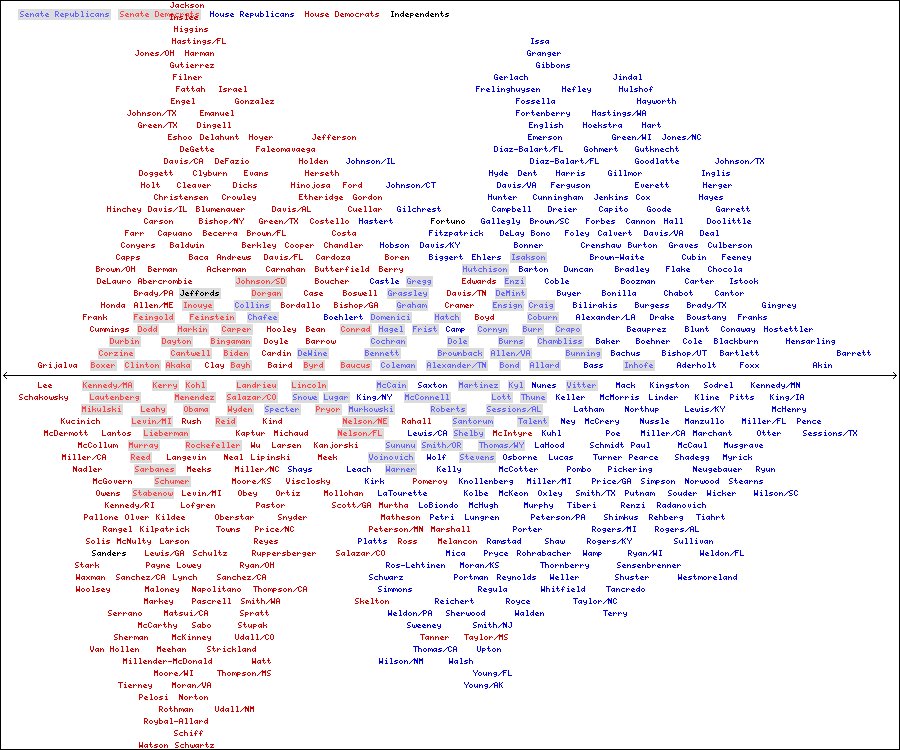
There's a pretty comprehensive description of how the positions were determined -- but basically, it comes from the bills which the Congressman or Senator co-sponsored. I'd like to see the same just for our delegation from North Carolina.
Tuesday, April 11, 2006
See?
WRAL is reporting (from the Fayetteville Observer story) that twelve of the state's poorest counties were in the top 25 for highest per capita sales of N.C. lottery tickets. Only three of the wealthiest were.
Most regrettable response:
Greg Taylor, chairman of the Bladen County Board of Commissioners, was surprised by the per capita spending amount, but said the county ultimately could benefit from the lottery when proceeds are disbursed to education programs.
http://www.wral.com/news/8617679/detail.html
In search of the historical Judas?
Dr. Al Mohler of Southern Baptist Theological Seminary writes on The Gospel of Judas here: http://www.albertmohler.com/commentary_read.php?cdate=2006-04-07 and explains why this certainly ancient text (3rd century A.D.) was "suppressed" at the time … and since.
Simply put, it's because when you are in the business of teaching truth, then you obviously must be opposed to disseminating fiction.
Another good article by Dr. Mohler.
(HT: The Cultural Report http://www.theculturalreport.com )
Monday, April 10, 2006
Progress in the air
A trio of environmental watchdog groups just released their study of the amount of smokestack emissions coming from the top 100 electrical power producers in the country. I note that International Paper and Alcoa are included as major producers, too; this should indicate how comprehensive a list the top 100 would be, since major industrial concerns even qualify. The report is linked from here: http://www.nrdc.org/air/pollution/benchmarking/default.asp
While my own Progress Energy is reported in the media as one of "the top 15 in air emissions" ("Progress among top producers" is the headline in Triangle Business Journal), as usual there are a few pieces of data which paint a very different story. The key overall is not the simple sum of all emissions, but the rate compared to the output. Here's the story from the report's own data:
- Duke Power and Progress Energy are the 8th and 9th largest producers of electricity in the U.S., respectively
- On sulphur dioxide, looking at pounds of emission per megawatt-hour of electricity produced, Progress is 23rd in the country (with more scrubbers coming online since the data was collected) and Duke is 41
- Mercury from coal-fired plants, Progress is number 46 and Duke is 59
- Carbon dioxide, 55 and 67
- Nitrous oxides, 66 and 80
So in other words, both companies are in the top 10% of electricity producers, yet for most measures, they put less junk up the stack for each megawatt of power than over half of the industry leaders. Comparisons aren't everything, but it tells me that North Carolina's power producers are doing pretty well for the industry.
Thursday, April 06, 2006
ASIGH Pride
In the ongoing uproar over the latest immigration reform bill, I'd like to say that I am ASIGH and proud. That's Anglo-Scot-Irish-Germano-Huguenot. There's some Swiss on my father's side, maybe a bit of Welsh, too, but that made the acronym unwieldy. (This conservative is very much in favor of immigration and immigrants, so long as everyone abides by the rules. The best jobs I had in high school were working for men with names like Athanasios, Hieronymous, and Georgios.)
Of course, eventually you have a statute of limitations on your immigrant status; at its nearest approach, I'd have to say I'm just a fifth-generation American (via Scot-Irishman James Mack, who came from Belfast to Charleston in 1825). The English (Parris, Ensley, Pinckney, Routledge), Scot (MacLeod, MacDowell), Irish (Brookshire, Kelly), German (Schluter, Weiss, Pullig, Marstellar) and Huguenot (DuTartre, D'Oyley) all date from earlier than that; so does the Swiss (Rebsamen).
In fact, though my Parris and DuTartre ancestors both arrived in the 1600's (to Massachusetts and South Carolina, respectively), my wife wins on the "First American" question -- her great-great grandmother was Cherokee.
Wednesday, April 05, 2006
Book Review -- Joseph Ellis' American Sphinx
I just finished Joseph Ellis' 440-page biography of Thomas Jefferson, American Sphinx. Ellis is very readable, and there is always a good-natured tone to his prose. He is very frank about the inconsistencies and idiosyncrasies of his subject, another iconic figure like His Excellency, George Washington. Certainly there is no shortage of contradictions to observe, and Jefferson ultimately never even recognized most of them.
A friend who got his PhD from the University of Virginia had the experience of Jefferson that Ellis, growing up in Alexandria, did of Washington -- he was simply a natural force, ubiquitous in the environment. My friend, not a fan of Jefferson anyway, didn't care for American Sphinx, and I can see some oddities about the book that may have bothered him. Ellis jumps around a bit when you compare his chapter headings with the actual text, such as quite consciously dating the chapter dealing with Jefferson's second term after he retired to Monticello. The best I can say is ignore the headings. There is practically nothing about Jefferson prior to the Continental Congress, which Ellis probably did because many of the contemporaneous sources were lost in a fire at Jefferson's Shadwell property. The new information which came out in the DNA study linking Jefferson with Sally Hemings is awkwardly appended to the original appendix, though the introduction to the paperback revised edition does warn the reader at the start (relevant material is inserted smoothly into the main text).
All in all, though, I found it a useful book. The major observations highlighted are Jefferson's tendency to think in moral dichotomies, not at all nuanced like the modern liberals we associate with him. In fact, as Ellis points out from his perspective in the mid-1990s, the conservative wing of the GOP is most like Jefferson in its ingrained suspicion of expansive government power (a suspicion sunk beneath the surface in the present administration). Jefferson's command of written language was probably unmatched in his time (as Chernow noted, Alexander Hamilton, while brilliant in thought, was often prolix on paper), but he indulged himself from the very beginning with fantasies of societies running smoothly without government at all, once people were freed from the weight of residual feudalism and monarchies (he included Adams's and Hamilton's version of Federalism in the latter vein). Any realities which intruded on his philosophical reflections were simply denied a place in thought; the existence of slavery in his home life, for example, was made as invisible as possible. In fact, while Jefferson was documentably duplicitous, treacherous even, toward his political opponents, he seemed to truly expert in self-deception more than any thing else.
Overall, I admire his language skills and the nobility of many of his expressions, but I have a mixed pity and dislike for the character of the man. I have to agree with the sentiment attributed to David McCullough, who supposedly started to write a dual biography of Jefferson and John Adams, and grew so tired of the backbiting Sage of Monticello that he relegated him to be a supporting character in the Pulitzer-winning biography, John Adams, that was finally written. American Sphinx is a useful book for understanding why that would be.
Watch out for reassuring instructions
"Even the cow was smiling."
Eldest son was working on a biology lab last night, and the manual explained "this is part of the fun and challenge of science". This is always a warning sign.
It reminded me of the line above, in James Herriot's All Creatures Great And Small, when he reflected on the laboratory-clean, straightforward version of calving in his vet school textbooks. At the moment, he was laying face down on a "muddy" barn floor struggling with the inner workings of a straining heifer.
Apparently Ivory Towers also have Ivory Barns, as well as an Ivory Laboratory.
Tuesday, March 28, 2006
After [Home-]School Activities
There have been several articles the past year about homeschoolers and extracurricular activities; here's my contribution to the stack. My personal theory is that for many folks, the face of "education" is not so much the classroom as it is the football game, band concert, or some other public event. Why that would be, I can't say -- maybe we all tend to gloss over the routine day-by-day life of school, in favor of the more exciting activities we remember, or the outside events we can share with our children.
How else can I interpret the response of near-relief I see when I talk about what homeschoolers do when they're not hitting the books? Apparently even some of our friends fear that we're hunkered down behind raised drawbridges, peering out at a confusing and frightening world through the embrasures of our little 3-bed 2-bath castles.
Sorry, we're not in right now; we'll be glad to call when we get back from basketball practice, band rehearsal, and debate class.
Homeschoolers Branching Out
Sports, music, and debate competitions among the extracurriculars
RALEIGH — The popular image of homeschooling is a mother and her children leaning over the kitchen table or gathered in the family room with their schoolbooks. This is not inaccurate for most families, but it is far from complete.
Studies show homeschooled students are involved in many after-school activities along with their public and private-school counterparts, such as scouting, 4-H, church groups, and sports leagues. Yet home educators also are building their own programs to provide more of the traditional high-school activities, such as varsity athletics, band, and academic clubs. …
(Carolina Journal Online, March 27; print edition, April 2006)
Monday, March 20, 2006
New News
This just in from my friend Joe Wirtz at The Cultural Commission -- a new news blog called The Cultural Report. Today was the first time I've read it but it looks good.
Thursday, March 16, 2006
A moment of weakness
I went out to lunch with some friends and associates today, and while we discussed politics and business matters over Thai chicken, grilled salmon, and Philadelphia steak sandwiches, at one point conversation got right chummy about personal experience with Volkswagens and tubas.
Everyone had a Volkswagen story, and three of the four had tuba anecdotes.
Talk about strange affinity. The parties will remain nameless but I can say it included an economist, two newspaper editors, and an engineer, all from different states.
Wednesday, March 08, 2006
More graceful towers
The trade journal Transmission & Distribution World reports that the Finnish municipal utility Helsinki Electric had to upgrade their existing 110kV lines and their 50-year-old lattice-steel towers, to support the seven-fold increase in electrical demand since the lines were first built. However, due to the critical location of the right of way through a scenic part of Helsinki, they enlisted a veteran industrial designer to create a more artistic tower.
Professor [Antii] Nurmesniemi presented an A-shaped tower made of rounded steel elements that satisfied structural demands and, when seen from a distance, also looked graceful. An architect's slogan is: “If you cannot hide a structure, make it visible.” Besides this original design, the color of the towers was to be nontraditional. A blue color was chosen purposely to stand out from colors that appear in nature.
Personally, I've always loved steel latticework, whether in a bridge or a tower structure. But here's the Professor's take on a more graceful powerline, dubbed "Antii's Steps" in his honor.The photo appears on the webpage of the construction firm Eltel Networks.
Wednesday, March 01, 2006
Speaking at HOME
Melanie and I had the opportunity to speak at a meeting of the HOME support group -- Homes Offering Meaningful Education -- in Fayetteville this week. Good friend and fellow board member Sandi Crosmun had asked us months ago if we could come, and not knowing the timing of this week's chicken pox epidemic, we said certainly.
Well, thankfully, our oldest son is a fully-qualified and very capable babysitter, and since HOME asked if we would do our presentation on "Strengthening the Homeschooling Marriage", which we've done quite a few times and already revised once -- it didn't take a great deal of new preparation in the midst of the spots.
We got a very warm welcome and many thanks from a good-sized group -- I counted 53, about a third of them men, which is an encouraging turnout for a local group. Many thanks to Sandi for inviting us down … It's always good to meet with folks on the same journey!
Subscribe to:
Posts (Atom)

 Posts
Posts


